 Airpods & Earbuds (Unboxed)
  Camera & Lenses (Unboxed)
  Headphones (Unboxed)
  Laptops (Unboxed)
  MacBooks (Unboxed)
  Mobile Accessories (Unboxed)
  Monitors (Unboxed)
  Wearables (Unboxed)
  Laptops (Grade A)
  Monitors (Grade A)
  Smartphone (Grade A)
Short answer: The 50-point check is a fixed inspection every unit must pass before it can be listed — 50 named tests covering processor, RAM, SSD health, battery, display, keyboard and trackpad, each port individually, Wi-Fi, Bluetooth, camera, mic, speakers, hinges, thermals under load, BIOS and firmware, and data erasure. Every point has a rule that disqualifies the unit. Units that fail and cannot be restored to standard are not listed at all. The Dell Latitude 7490 at ₹22,490 passed all 50.
Prices are live as of 29 September 2026 and move with stock — check the linked product page for today’s exact price.
Why does a quality check need publishing at all?
Because “certified” is the most abused word in Indian refurbished electronics. Anyone can type it on a listing. It means nothing until someone says what was tested and what happens when a unit fails.
So this page is the receipt behind every Grade A Certified badge on newasnew.in. Pick any line and ask what your unit scored. A seller who cannot answer is selling decoration.
What are the 50 points, exactly?
| Points | Area | What is actually tested |
|---|---|---|
| 1–2 | Identity and provenance | Serial or IMEI read from hardware and matched to firmware; not reported blocked or stolen; no activation lock. |
| 3–6 | Processor and performance | Model and generation confirmed in firmware against the listing; all cores present; a sustained multi-core load run to completion, clocks logged. |
| 7–11 | Memory and storage, including SSD health | RAM capacity and slot layout; full memory error pass; NVMe or SATA confirmed; SMART read for reallocated and pending sectors, power-on hours, wear; read and write speeds. |
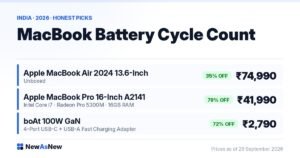
| 12–15 | Battery health | Full charge capacity against design capacity; cycle count; a timed discharge under real use, not a spec-sheet estimate; swelling. |
| 16–20 | Display | Colour flats at black, white, red, green, blue for dead and stuck pixels; backlight bleed in a dark bay; peak brightness; uniformity; touch response. |
| 21–24 | Keyboard and trackpad | Every key pressed individually and logged; backlight zone by zone; trackpad click, scroll, multi-touch, palm rejection; fingerprint and face login where fitted. |
| 25–31 | Every port, individually | Each USB-A with a live device; each USB-C separately for data, display output and charging, because the shape does not tell you what a port does; Thunderbolt where claimed; HDMI to a monitor; Ethernet at rated speed; SD card; 3.5mm in and out. |
| 32–34 | Wireless | Wi-Fi on both 2.4GHz and 5GHz with a throughput test, not just a connection; Bluetooth paired, streamed, re-paired out of range; antenna leads checked for seating, since a pinched cable shows full bars and poor range. |
| 35–38 | Camera, microphone and speakers | Webcam focus, exposure, privacy shutter; mic array recorded and played back for level and noise; left and right speakers driven separately across the range; one full video call. |
| 39–42 | Chassis, hinges and fasteners | Hinges to full travel, checked for wobble and the cracked mounts common on old fleet laptops; lid and sleep sensor; every base screw; panels under strong light, each mark photographed. |
| 43–45 | Thermals under load | Heatsink and fan cleaned, paste renewed; fan noise through its range; a sustained CPU and GPU load with temperatures and clocks logged until stable, not a 30-second burst. |
| 46–48 | BIOS and firmware | BIOS, system and drive passwords cleared to Not Set; corporate device-management enrolment and remote-management provisioning removed; the previous employer’s asset and owner tags wiped; BIOS updated. |
| 49–50 | Data erasure and clean image | Drive erased at hardware level, erase verified; machine imaged with a clean, genuinely licensed OS install, left at the out-of-box setup screen. |
The hard fails, no exceptions: a blocked serial or activation lock, any memory error, any reallocated or pending sector, a swollen battery, one dead pixel, one dead key, a port that will not do its advertised job, a cracked hinge mount, clocks that collapse under load, a BIOS password or enrolment we cannot clear, a drive that refuses a verified erase.
Consumables — battery, keyboard, drive, paste — we replace, then re-test from point 1. Structural and firmware faults mean the unit is not listed. We never downgrade a failure into a cheaper listing, or call a fault a “minor issue” and let the price apologise: see the devices we reject.
What does Grade A Certified mean, and how is Unboxed different?
Two different things, and blurring them is the exact dishonesty this company exists to oppose.
Grade A Certified means the unit was genuinely owned and used before, usually in a company fleet, and restored to standard by us. It passed all 50 points. It may carry light cosmetic marks, every one photographed on the product page before you pay. It is used. We say so.
Unboxed means a sealed retail product whose box was opened and which was essentially never used: a cancelled order, a return inside the cooling-off window, a display piece. Cosmetically like new. It still goes through the functional half of this check, because an open box says nothing about whether it works.
Grade A Certified is used and restored; Unboxed is new but not sealed. More: Unboxed vs refurbished vs Grade A.
What we deliberately do not claim
No named certification, ISO number or third-party audit. “Certified” here means certified by us, against the 50 points above. We will not borrow the authority of a standards body we do not belong to.
No rejection rate, failure rate or average battery health. Sellers quote neat figures — so many in ten rejected, such-and-such percent failing. We have no audited dataset behind any such number, so we will not print one. The process is what is true: 50 tests with fail rules, and failures that cannot be restored are never listed. The day a number appears here, its methodology comes with it.
No data-erasure certificate against a named standard. We erase at hardware level, verify it, and will tell you in writing what was done to your unit.
How do you verify any of this yourself?
Do not take our word for it — take the seven days.
Watch the first boot: a properly imaged machine lands on the out-of-box setup screen asking your region and your name. Open the BIOS — F2 on a Dell Latitude, F10 on an HP EliteBook — and confirm every password reads Not Set and no asset tag remains. Check the battery against the product page figure: battery health in 60 seconds, what 80% means. Plug something into every port. Run a real workload for an hour and listen to the fan.
Anything that disagrees with the listing, message us inside the 7-day window: that is a return or replacement under our returns process and warranty.
Which in-stock units passed this check?
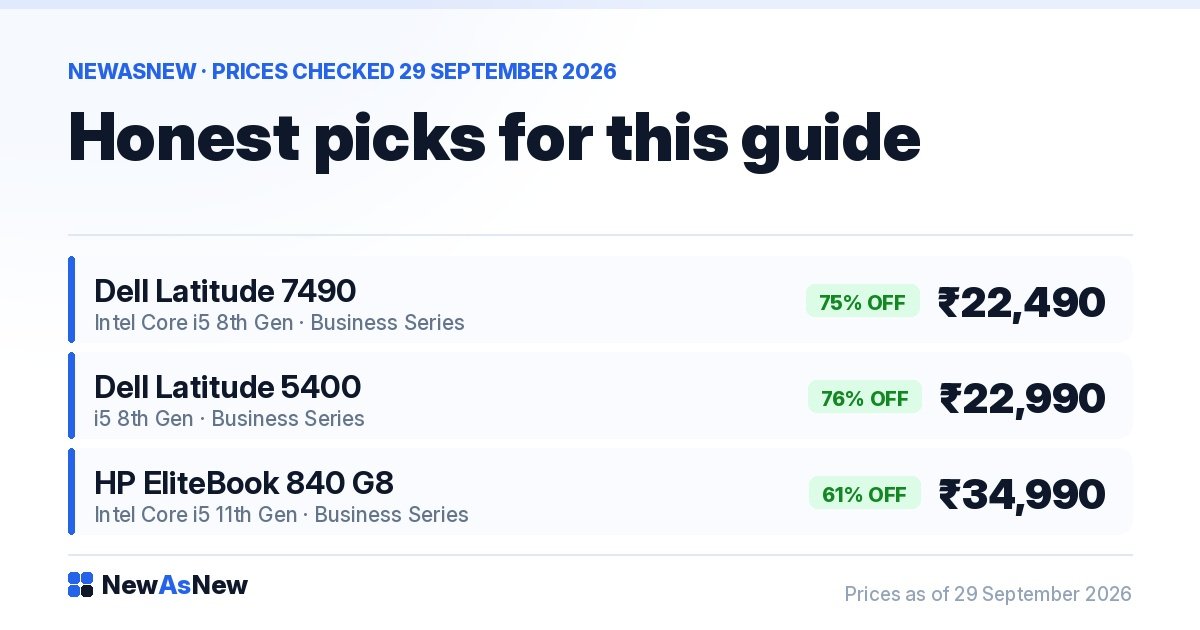
All of them, or they would not be listed. Mostly ex-corporate Dells and HPs, built to be opened, tested and repaired. Four to open today:
- Dell Latitude 7490 i5 8th Gen — ₹22,490 (MRP ₹88,999, 75% off). Grade A Certified. At this age, points 39–42 matter most.
- Dell Latitude 5400 i5 8th Gen — ₹22,990 (MRP ₹94,999, 76% off). Grade A Certified. Press F2 and verify points 46–48.
- HP EliteBook 840 G8 i5 11th Gen — ₹34,990 (MRP ₹89,999, 61% off). Grade A Certified. Re-test 25–31: drive a monitor off USB-C.
- Apple MacBook Air 2024 M3, 8GB / 256GB — ₹74,990 (MRP ₹1,14,990, 35% off). Unboxed, not Grade A: cosmetics are trivial, so the functional half is the job.
Who should not buy on the strength of this check?
If your procurement needs a certificate against a named standard. Government, defence and regulated-finance buyers need audited paperwork with a standards number. We do not have it and will not fake it. Buy from an IT asset disposal vendor.
If you need a machine that never belonged to anyone. No inspection makes a used laptop unused. Buy Unboxed or new, and pay the difference honestly.
If a faint scratch will bother you. Grade A Certified is a functional standard with disclosed cosmetics, not a cosmetic guarantee. Buy Unboxed.
If you will not do the day-one checks, or you shop purely on price. A real check costs money, so there is always a cheaper unit from someone who tested nothing — read the seven mistakes buyers make and how to buy without getting cheated first.
What “Excellent” battery health means here: above 80% of original design capacity on a laptop, and above 85% on a smartphone. The thresholds differ because the two age differently — a laptop spends most of its life on mains power, a phone is cycled every day. Anything below that is not listed; there is no lower battery tier. The measured figure for your exact unit is printed on its product page.
Frequently asked questions
What does the NewAsNew 50-point quality check include?
Fifty named tests in 13 areas, from processor, memory and SSD health, battery and display to keyboard, every port individually, wireless, camera, hinges, thermals under load, BIOS and firmware, and verified data erasure.
Is the check certified by anyone outside NewAsNew?
No. It is our own standard, applied by our own technicians in New Delhi and published in full so you can hold us to it. We hold no ISO number and no external audit.
What percentage of units fail the check?
We do not publish one: we have no audited dataset behind it, and an invented number is worse than none. What is true is that units failing the check and not restorable to standard are never listed.
Does every product go through all 50 points?
Every laptop does. On a phone, headphones or a monitor, points that do not physically exist are swapped for that device’s equivalents — cellular and SIM, driver channels, panel inputs. The fail rules do not loosen.
What battery health do you accept before listing a laptop?
Our floor is 80% of design capacity. Below that the battery is replaced or the unit is not listed, and the measured figure for your unit is on its product page to check on day one.
Do you clear BIOS passwords and corporate enrolment?
Yes, and it is a hard fail if we cannot. Passwords must read Not Set, device-management and remote-management provisioning removed, and the previous employer’s asset tags gone from firmware.
What do I get in writing when I buy?
A GST invoice in your or your company’s name, the NewAsNew warranty, and 7 days to return. Windows is a genuinely licensed clean install: see Windows licences, GST invoices, warranty cover.
Where to go next
Under ₹25,000, under ₹35,000, under ₹50,000, or the 15-question checklist.
Want to know how your unit scored on one point — the battery figure, the hinge, the USB-C port? Message us on WhatsApp with the model and we will answer in writing before you pay.
Written by the NewAsNew team, NextG Serve Pvt. Ltd., New Delhi. We inspect, repair and grade every unit ourselves against the 50 points above, and reject what we cannot bring to standard. Our story.
Why our grade is the strictest in the business
Most refurbished sellers in India grade downwards. A unit arrives, it fails the top standard, so it becomes a Grade B. It fails that, it becomes a Grade C. Nothing is ever really rejected, because every grade is another shelf to put it on. That is how a “certified refurbished” market ends up full of devices nobody would certify.
We run one grade, and one answer. Every device that reaches our bench goes through a 50-point check. Only 2 to 3 out of every 10 pass. The other 7 to 8 go back to the supplier — not down a grade, not onto a marketplace, not into a clearance bin. Back. We have no Grade B to hide a failure in, which is precisely why our Grade A means something.
That is the whole business in one sentence: not every product deserves to be sold. We would rather ship nothing this week than ship something that will come back to you in three months. It is an expensive way to run a refurbishing operation and it is the reason we will not be the cheapest seller you find.
We publish the pass rate as a range rather than one flattering number, because the real figure moves month to month with the stock we are offered. Anyone can quote a percentage. Explaining why you refuse to quote a single one is harder to fake — and we have yet to find another refurbisher in India who rejects seven in ten and says so publicly.
Every unit that does pass ships with a 6-month NewAsNew Assured Warranty, a GST invoice in your name, 7-day returns and no-cost EMI. The full 50-point process is documented here, and the published criteria are here — read them before you buy from anyone, including us.
Related guide
Before a unit reaches the 50-point check, it has to come from somewhere — we explain exactly where: