 Airpods & Earbuds (Unboxed)
  Camera & Lenses (Unboxed)
  Headphones (Unboxed)
  Laptops (Unboxed)
  MacBooks (Unboxed)
  Mobile Accessories (Unboxed)
  Monitors (Unboxed)
  Wearables (Unboxed)
  Laptops (Grade A)
  Monitors (Grade A)
  Smartphone (Grade A)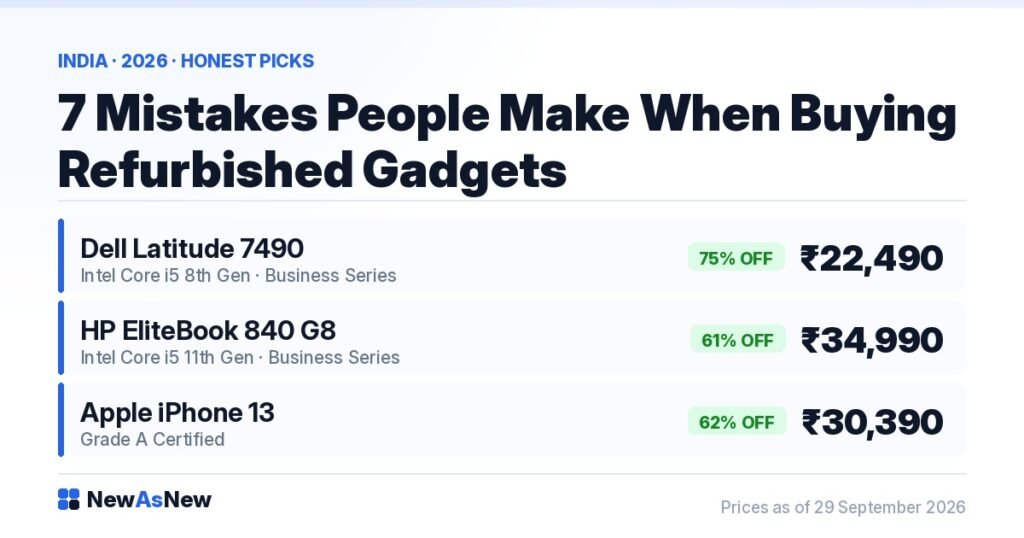
Short answer: The seven mistakes are buying on price alone, not asking for battery health as a number, accepting a vague warranty, skipping the IMEI check on phones, buying “refurbished” from unverified sellers, ignoring the return window, and not testing on day one. Buying from a seller who states condition and gives a GST invoice, a written warranty and 7-day returns removes most of the risk — a Dell Latitude 7490 at ₹22,490, 75% off its ₹88,999 MRP, comes with all four.
Prices are live as of 29 September 2026 and move with stock — check the linked product page for today’s exact price.
Buying refurbished is a good decision in India in 2026. It also rewards care in a way buying new does not, because with a used device the seller’s honesty is part of the product. These are the seven mistakes we see repeatedly — often from people who then buy from us and tell us what went wrong last time.
Mistake 1: Buying on price alone
The cheapest listing is almost never the best purchase. A ₹3,000 saving evaporates the first time you pay for a screen, or spend three weeks chasing a seller who stopped replying. Price is also the easiest thing to compare, which is exactly why weak sellers compete on it — condition, QC, warranty and recourse are harder to compare, so they get quietly dropped, and those are what you are actually buying when you buy used.
Fix: Compare four things before price: what the QC actually tests, what the warranty covers in writing, whether a GST invoice is issued, and how long the return window runs. If two sellers are ₹2,000 apart and only one answers those four, the cheaper one is not cheaper. See also how to spot a fake discount in India — a dramatic percentage off an inflated MRP is not a saving.
Mistake 2: Not asking for battery health as a number
Battery is the one component that ages whether or not anybody used the device, and the one sellers are least likely to volunteer information about. A laptop with a worn battery is a desktop that has to stay near a socket. The tell is vagueness: “battery is good” and “battery health excellent” are answers containing no information.
Fix: Ask for the actual figure on the actual unit, with a screenshot. On an iPhone that is Settings, Battery, Battery Health. On Windows you generate a battery report in about a minute — the command is in how to check laptop battery health in 60 seconds. Then judge the number against the device’s age, which is what battery health explained and refurbished iPhone battery health are for. Budget for a replacement eventually on any used device — battery is a consumable and no warranty covers wear.
Mistake 3: Accepting a vague warranty, or no invoice
“Thirty-day seller protection” and “contact us if there is an issue” are not warranties. They are sentences. A warranty answers specific questions, and a seller who cannot answer them before you pay will not answer them after.
| Ask this before paying | A weak answer sounds like | Why it matters |
|---|---|---|
| How long is the cover, and where is it written? | “Don’t worry, we will take care of it” | Verbal cover is unenforceable |
| What exactly is covered? | “Everything” | Nobody covers drops or liquid; “everything” means nothing |
| What is excluded? | Silence | An honest seller volunteers the exclusions |
| How do I start a claim? | “Just message us” | You need a defined route, not a hope |
| Will I get a GST invoice in my name? | Deflection, or a discount for skipping it | No invoice means no legal proof of purchase |
The invoice deserves emphasis, because buyers routinely waive it to save a little money. A GST invoice is your evidence that you bought this device, from this business, on this date, for this amount. Without it you have no warranty claim, no consumer-forum recourse and no input tax credit. Sellers who resist issuing one are telling you how they intend to behave later. See GST invoices on refurbished laptops and refurbished laptop warranty in India.
Fix: Get the warranty terms and the invoice commitment in writing — a WhatsApp message counts — before you transfer money.
Mistake 4: Not verifying the IMEI on a phone
Stolen and blocked handsets circulate in the Indian grey market. They work perfectly when you test them. The problem arrives later: once a handset is reported and blocked on the government’s Central Equipment Identity Register, it stops connecting to Indian networks, and no refund or repair fixes that.
Fix: Before paying for any second-hand phone, get the IMEI from the seller and check it yourself on the CEIR portal at ceir.gov.in. Dial *#06# on the handset to read the IMEI off the device and confirm it matches the box, the invoice and what you were told. A seller who will not give you the IMEI in advance has answered your question. Full sequence: how to check if a refurbished phone is genuine and the refurbished iPhone checklist.
Mistake 5: Buying from an unverified seller — and paying in advance
“Refurbished” is not a regulated word in India. Anybody can type it. On classifieds it frequently means “used, wiped, photographed well” and nothing more — no testing, no grading, no warranty, no invoice, no recourse.
Those platforms are fine for what they are designed for: meeting a seller, inspecting a device in person, testing it in front of them, and paying once satisfied. They are dangerous for shipping money to a stranger on the strength of five photographs.
The related trap is the payment. A request for the full amount in advance to a personal UPI ID or bank account, rather than a business account with an invoice, removes every protection you have. So does a push to move off-platform, or to pay a “booking amount” to hold a unit. These are the standard mechanics of the scam, and they work because the price is attractive enough to make people ignore them.
Fix: Buy from a business that publishes a QC process, a written warranty and a return window, and that invoices you properly. Or, buying from an individual, meet them, test everything and pay on handover. Never send the full amount in advance to a personal account. Our process is documented in how the 50-point quality check actually works; the broader question is answered in is it safe to buy a refurbished laptop online in India.
Mistake 6: Ignoring the return window
Some faults do not present on day one. A battery that looks fine on a full charge reveals itself by day four. A key that works cold jams once the chassis warms up. A fan bearing silent at idle groans under load. That is why “dead on arrival only” policies are close to worthless: the faults a used device is most likely to have are exactly the ones that take a few days to appear.
Fix: Treat 7 days from delivery as the minimum acceptable window, and read what it covers — whether it covers “not working properly” or only “completely dead”, and whether change of mind is included. Ours is in our returns process explained.
Mistake 7: Not testing immediately on arrival
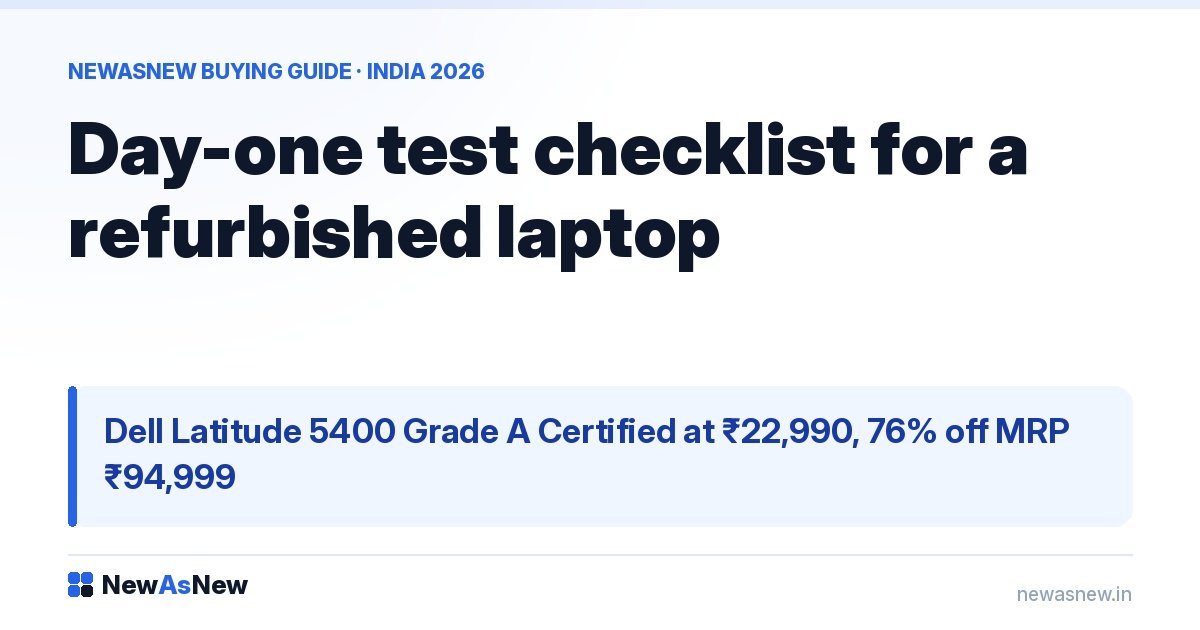
Return windows run from delivery, not from the day you opened the box. Leaving a new arrival untested for a week burns most of your protection for no reason. This is the cheapest mistake here to avoid and the most common one we see.
Fix: Set aside thirty minutes on the day it arrives.
| Check | How |
|---|---|
| Specs match the listing | Windows key, type “System Information”. On Mac, Option + Apple menu |
| Battery health figure | Battery report on Windows; Settings > Battery on iPhone |
| Every port | Plug something into each USB, USB-C, HDMI and audio jack |
| Screen defects | Full-screen white image, then full-screen black image |
| Keyboard and trackpad | Type a full pangram; test right-click and two-finger scroll |
| Wi-Fi, Bluetooth, camera, mic, speakers | One video call covers all five |
| Sustained load | Run something heavy for 20 minutes; listen to the fan |
| Windows licence activated | Settings > System > Activation |
| Invoice received and correct | Check the name, date, amount and GST details |
Keep the box and accessories until you are past day seven. If anything is off, message the seller the same day with photos — a problem reported on day one is a different conversation from the same problem on day nine.
Who should not buy refurbished at all?
If you will not do any of the checks above, buy new. Not as a criticism — some people genuinely do not want to verify an IMEI or test ports on arrival. Buying new transfers that diligence to the manufacturer’s warranty and you pay a premium for it. That is a legitimate trade, and better than buying used carelessly.
If you need multi-year cover, or current-generation capability, buy new. Refurbished cover from any seller is shorter than a new machine with an extended manufacturer pack, so if a week without the device costs you real money and you have no spare, spend the extra. Likewise a current GPU for ML or 4K editing, on-device AI features or the newest connectivity standard — these are absent rather than merely slower, and no discount fixes absent.
If the price seems too good, walk away rather than investigate. A flagship phone at a third of its realistic used price is not a deal somebody overlooked. It is stolen, blocked, counterfeit, or a listing that will take your money and vanish. We would rather you bought nothing than bought that. Further reading: refurbished vs second-hand.
What “Excellent” battery health means here: above 80% of original design capacity on a laptop, and above 85% on a smartphone. The thresholds differ because the two age differently — a laptop spends most of its life on mains power, a phone is cycled every day. Anything below that is not listed; there is no lower battery tier. The measured figure for your exact unit is printed on its product page.
Frequently asked questions
What are the most common mistakes when buying refurbished gadgets?
Buying on price alone, not asking for battery health as a specific number, accepting a vague warranty with no invoice, skipping the IMEI check on a phone, buying from an unverified seller and paying in advance to a personal account, ignoring how long the return window runs and what it covers, and not testing the device on the day it arrives.
Do I really need a warranty and a GST invoice?
Yes. A written warranty tells you what is covered, what is excluded and how to claim — all three, or it is not a warranty. A GST invoice is your legal proof that you bought this device, from this business, on this date, for this amount. Without it you have no warranty claim, no consumer-forum recourse and no input tax credit.
How do I avoid getting cheated buying refurbished in India?
Ask for three things before paying: the warranty terms in writing, a GST invoice in your name, and the exact grade with real photographs of the specific unit. For phones, verify the IMEI yourself on the CEIR portal at ceir.gov.in. Never send the full amount in advance to a personal UPI ID or bank account, and do not agree to a “booking amount” to hold a unit.
What battery health should I accept on a refurbished device?
Ask for the actual figure on the actual unit with a screenshot, rather than accepting “battery is good”. Judge that number against the device’s age — what is reasonable on an eight-year-old business laptop is not the same as on a two-year-old iPhone. Expect to replace the battery eventually on any used device; it is a consumable and no warranty covers ordinary wear.
How do I check if a refurbished phone is stolen or blocked?
Get the IMEI from the seller before paying and check it on the CEIR portal at ceir.gov.in. Dial *#06# on the handset to read its own IMEI and confirm it matches the box, the invoice and what you were told. A blocked handset works perfectly until it is cut off from Indian networks, and nothing you do afterwards fixes it.
What should I test on the day my device arrives?
Specs against the listing, the battery health figure, every port, the screen on a full white and a full black image, every key and the trackpad, then Wi-Fi, Bluetooth, camera, microphone and speakers in one video call. Run something heavy for twenty minutes and listen to the fan, confirm Windows is activated, and check the invoice details. Keep the box until day seven has passed.
Where to go next
If you want to see what a listing looks like when a seller answers all seven questions up front, these are in stock today:
- Dell Latitude 7490, Core i5 8th Gen, Grade A Certified — ₹22,490 (MRP ₹88,999, 75% off)
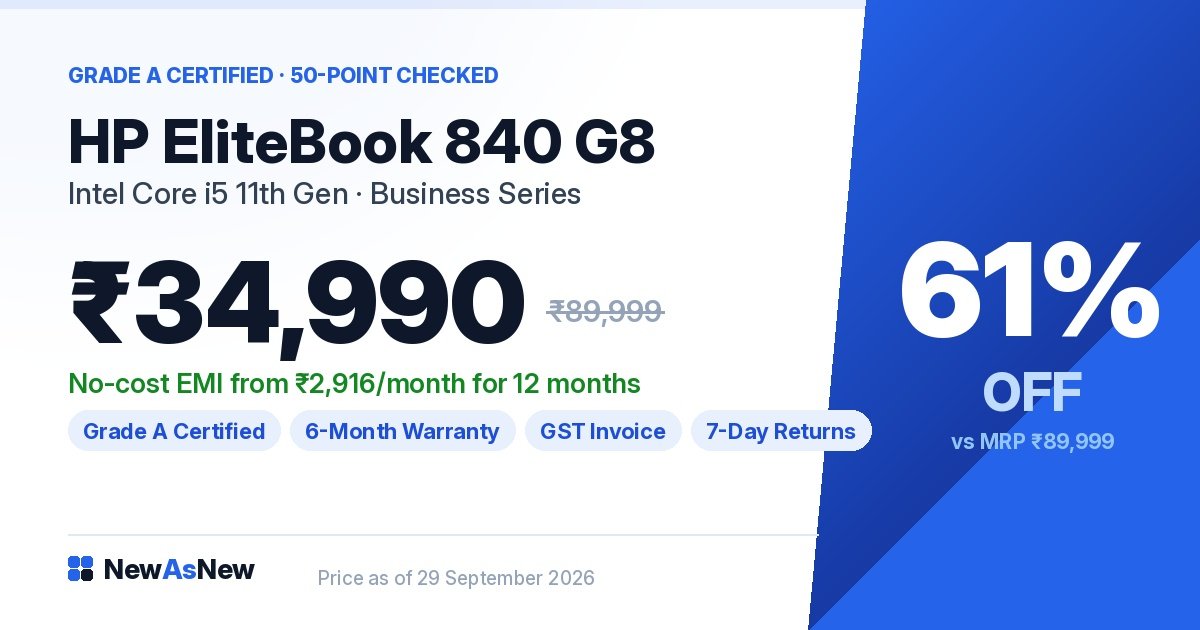
- HP EliteBook 840 G8, Core i5 11th Gen, Grade A Certified — ₹34,990 (MRP ₹89,999, 61% off)
- Apple iPhone 13, Grade A Certified — ₹30,390 (MRP ₹79,900, 62% off)
- Sony WF-C510 TWS earbuds, Unboxed — ₹2,990 (MRP ₹8,990, 67% off)
Every one carries the 50-point quality check, NewAsNew Assured Warranty, a GST invoice and 7-day returns. Browse all refurbished and unboxed laptops or all certified refurbished phones. Still deciding on grade? Read how to choose between Unboxed and Grade A.
Want a second opinion on a listing you found elsewhere? Send it to us on WhatsApp — +91 79822 35917. We will tell you honestly whether it looks sound, even when the answer costs us the sale.
Written by the NewAsNew team in New Delhi. We inspect every unit against the 50-point check ourselves, and reject the ones that do not qualify rather than grade them generously. Not every product deserves to be sold. Read our story.