Airpods & Earbuds (Unboxed)
  Camera & Lenses (Unboxed)
  Headphones (Unboxed)
  Laptops (Unboxed)
  MacBooks (Unboxed)
  Mobile Accessories (Unboxed)
  Monitors (Unboxed)
  Wearables (Unboxed)
  Laptops (Grade A)
  Monitors (Grade A)
  Smartphone (Grade A)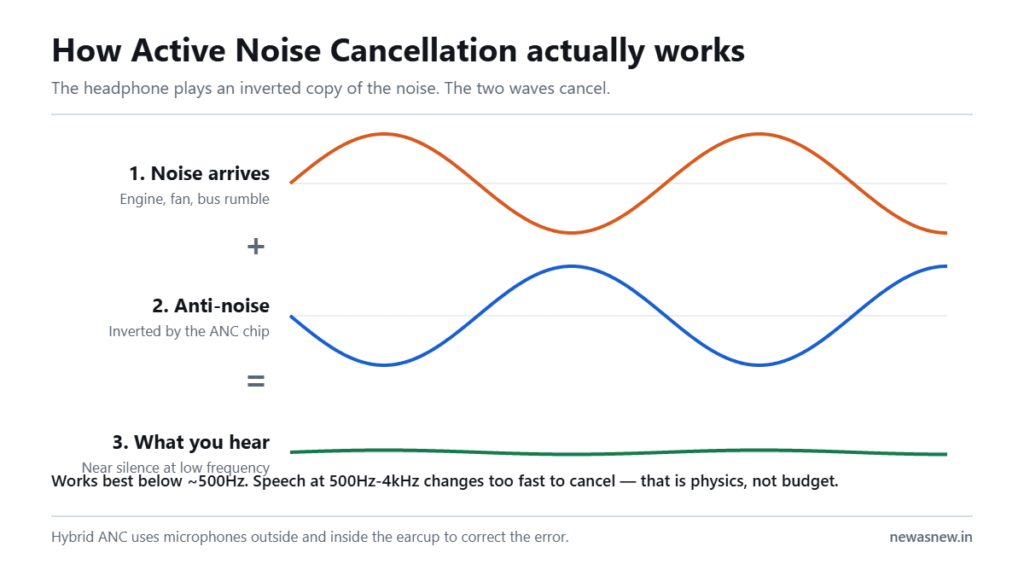
Short answer: ANC makes the world quieter for you. ENC makes your voice clearer for the person on the other end of a call — it does nothing for what you hear. Passive noise isolation is just the physical seal of the earbud or earcup. Thousands of Indian listings advertise “ENC” in a way that reads like noise cancellation for the listener, and it is not. If you want quiet on your commute, you need ANC — which starts around Rs 990 in unboxed stock with the realme Buds Q2.
Prices are live as of 6 September 2026 and move with stock — check the linked product page for the current figure before you decide.
The three terms, side by side
| ANC | ENC | Passive isolation | |
|---|---|---|---|
| Full name | Active Noise Cancellation | Environmental Noise Cancellation | Physical isolation |
| Who benefits | You, the wearer | The person you are calling | You, the wearer |
| How it works | Plays an inverted sound wave into your ear | Filters background noise out of the microphone signal | The ear tip or earcup physically blocks sound |
| Best on | Low frequency: engines, fans, rumble | Steady background noise on your side of the call | High frequency: voices, clicks, clatter |
| Needs power | Yes | Yes | No |
| Costs battery | 20-30% of runtime | Only during calls | Nothing |
Why the confusion exists
Because ENC is cheap and ANC is not. Environmental Noise Cancellation is largely a software feature running on the microphone signal, so a manufacturer can add it to a Rs 800 earbud at almost no cost. Real hybrid ANC needs extra microphones, a dedicated processing chip and careful acoustic design.
So budget listings lead with ENC, often written as “ENC Noise Cancellation” or “4-mic ENC”, and buyers reasonably read the words noise cancellation and expect a quiet commute. They then get an earbud that does nothing for the metro rumble but does sound clear to their colleagues on a call.
Neither the feature nor the label is dishonest. The gap between what it says and what buyers hear is real, and it is worth naming plainly rather than repeating.
Which one do you actually need?
- You commute by metro, bus or train, or fly often. You need ANC. Nothing else touches low-frequency rumble.
- You take a lot of calls from noisy places — a shop, a site, a busy street. You need ENC, and good ENC genuinely matters. Your callers will notice it more than you will.
- You work in an open office and are bothered by conversation. Neither will solve this. Speech sits where ANC is weakest. Well-sealed in-ears with something playing is your best option.
- You want to hear music clearly while walking in traffic. You need good passive isolation plus a transparency mode. ANC here is a safety problem, not a feature.
What good passive isolation is worth
More than most people assume. A properly fitted silicone ear tip or a well-padded over-ear cup can reduce high-frequency noise by 15-25 dB on its own, with no electronics involved. That is a large amount, and it covers exactly the frequency band where ANC is weakest.
This is why the best ANC headphones are also the ones with the best seal. The two systems are complementary, not competing. It is also why fit is the single largest real-world variable in noise performance — a Rs 12,000 earbud with the wrong tip size will underperform a Rs 2,000 one that fits.
Practical test: put the earbuds in with nothing playing. If you can still hear the room clearly, go up a tip size. Most people are wearing tips that are too small.
What to look for on a listing
- “Hybrid ANC” or “Active Noise Cancellation up to XX dB” — this is real ANC.
- “ENC”, “4-mic ENC”, “AI call noise reduction”, “clear voice” — this is call quality only.
- “Noise isolating” with no mention of active anything — this is passive fit, which is fine and honest.
- “Transparency” or “Ambient mode” — lets outside sound in deliberately. You want this if you walk in traffic.
Who should NOT buy ANC
- Anyone cycling or walking on Indian roads. You need to hear horns. This is a safety matter.
- Anyone who only takes calls. Buy for microphone quality and ENC instead; ANC will just cost you battery.
- Anyone sensitive to ear pressure. Some people find strong ANC uncomfortable, similar to an altitude change. Buy where you can return it.
- Anyone under Rs 1,000 who prioritises sound. At that price ANC is added at the expense of the driver. A good non-ANC pair sounds better.
Live unboxed picks
| Model | Price | What it actually has |
|---|---|---|
| boAt Rockerz 330 | Rs 699 | Passive isolation, neckband, long battery |
| realme Buds Q2 | Rs 990 | Entry-level true ANC |
| realme Buds T300 | Rs 1,090 | ANC, better than the Q2 for commuting |
| realme Buds Air 5 Pro | Rs 2,490 | Strong ANC for the price |
| Sony WF-C510 | Rs 2,990 | Passive isolation only; excellent sound |
| JBL Tune 770NC | Rs 4,490 | Hybrid ANC over-ear |
| Sony WF-C710N | Rs 5,490 | Dual noise cancellation earbuds |
| Sony WH-CH720N | Rs 5,890 | The value benchmark for over-ear ANC |
| Bose QuietComfort | Rs 11,490 | The reference for commute silence |
What we can ship today
Every unit below is in stock as this page was last checked, with a 6-month NewAsNew Assured Warranty, GST invoice, 7-day returns and no-cost EMI. If it is listed here, we can dispatch it.
| Model | Price | MRP | You save |
|---|---|---|---|
| Sony WH-CH520 Wireless Bluetooth On-Ear Headphones with Mic 50Hrs Battery · Quick Charge · Multipoint Connectivity |
₹2,790 | ₹5,990 | 53% |
| Sony WH-CH720N Active Noise Cancellation Wireless Bluetooth Over-Ear Headphones with Mic Up to 35Hrs Battery · Customized EQ |
₹5,890 | ₹14,990 | 61% |
| Bose Noise Cancelling 700 Bluetooth Wireless Over-Ear Headphones with Mic Alexa Enabled & Touch Control |
₹14,790 | ₹34,500 | 57% |
| Sony WH-1000XM5 Best Active Noise Cancelling Wireless Bluetooth Over-Ear Headphones with Mic 30 Hours Battery Life |
₹21,990 | ₹34,990 | 37% |
Prices checked on 29 September 2026 — stock and prices move, so the linked product page is always the truth.
Browse all headphones in stock · Ask us on WhatsApp which one fits you
Frequently asked questions
What is the difference between ANC and ENC?
ANC reduces the noise you hear by playing an inverted sound wave into your ear. ENC reduces the background noise the person you are calling hears, by filtering your microphone signal. ENC does nothing for your own listening.
Is ENC useless then?
Not at all — it is very useful, just for a different purpose. If you take calls from noisy places, good ENC is the difference between being understood and being asked to repeat yourself. It simply is not noise cancellation for the wearer.
Do I need both ANC and ENC?
If you both commute and take calls, yes, and most mid-range earbuds now include both. Check the listing states them separately rather than blurring them into one phrase.
Which is better, ANC or passive noise isolation?
Neither, because they cover different frequencies. Passive isolation handles high frequencies such as voices and clatter; ANC handles low frequencies such as engines and fans. The best products do both.
Why do my ANC earbuds not block office chatter?
Speech sits at 500Hz-4kHz and changes constantly, which is the hardest thing for ANC to predict and cancel. This is a physics limit, not a fault or a price issue.
Does ENC drain battery?
Only during calls, and far less than ANC does. ANC typically costs 20-30% of total runtime because it runs continuously while you listen.
Related guides
- Unboxed headphones and earbuds: the full guide
- Sony vs Bose vs Sennheiser ANC compared
- Best unboxed noise-cancelling headphones
- What Active Noise Cancellation actually is
Still deciding? Talk to a human
Send us the work you do and your budget on WhatsApp and we will tell you honestly whether we have something for you — or whether you should wait. Chat with NewAsNew on WhatsApp (+91 79822 35917).
Browse live stock: Grade A Certified laptops · Refurbished iPhones · Unboxed headphones · Unboxed earbuds.
Written by Atul Pandey, co-founder of NewAsNew (NextG Serve Private Limited, New Delhi). We came from four years of offline electronics retail in Prayagraj before building NewAsNew. Only 2 to 3 out of every 10 devices that reach our QC bench pass; the other 7 to 8 go back to the supplier. The exact figure moves month to month with the stock we are offered, so we publish the range rather than one flattering number. Read our story.