Airpods & Earbuds (Unboxed)
  Camera & Lenses (Unboxed)
  Headphones (Unboxed)
  Laptops (Unboxed)
  MacBooks (Unboxed)
  Mobile Accessories (Unboxed)
  Monitors (Unboxed)
  Wearables (Unboxed)
  Laptops (Grade A)
  Monitors (Grade A)
  Smartphone (Grade A)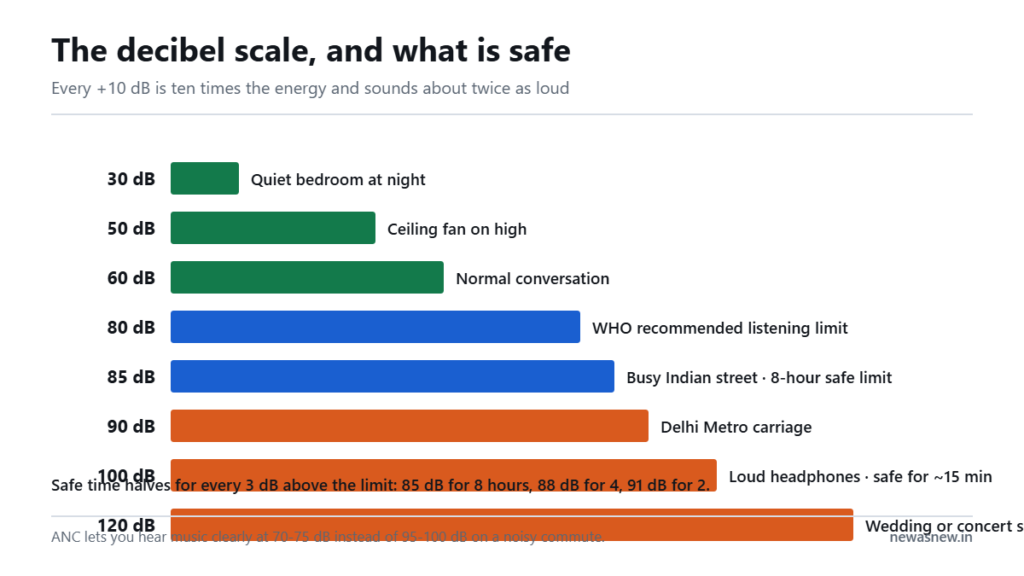
Short answer: A decibel is a logarithmic ratio, not a straight count. Every 10 dB of reduction removes 90% of the remaining sound energy, so a 30 dB ANC figure means roughly 99.9% of the energy at that frequency is gone. The catch that almost nobody prints: those headline numbers are peak reduction at one low frequency, not across the whole range. A Sony WH-CH720N at Rs 5,890 and a Bose QuietComfort at Rs 11,490 both quote impressive numbers and still differ audibly, because the shape of the curve matters more than its highest point.
Prices are live as of 6 September 2026 and move with stock — check the linked product page for the current figure before you decide.
Why is a decibel not a normal number?
Because human hearing spans an enormous range. The quietest sound you can detect and the loudest you can tolerate differ by about a factor of ten million in pressure. A linear scale for that would be unusable, so the decibel scale compresses it logarithmically.
The practical consequences:
| Change | Sound energy | What you perceive |
|---|---|---|
| +3 dB | Double the power | Just noticeably louder |
| +6 dB | 4x the power | Clearly louder |
| +10 dB | 10x the power | About twice as loud |
| -10 dB | 90% of energy removed | About half as loud |
| -20 dB | 99% removed | About a quarter as loud |
| -30 dB | 99.9% removed | About an eighth as loud |
Note the mismatch in the last two columns. That is the crucial insight: energy and perceived loudness are not the same thing. Removing 99.9% of the energy does not make something 1,000 times quieter to your ear — it makes it roughly eight times quieter. This is why the difference between a good and a great ANC headphone is real but never as dramatic as the specification gap suggests.
How loud are everyday sounds in India?
| Sound | Level | Note |
|---|---|---|
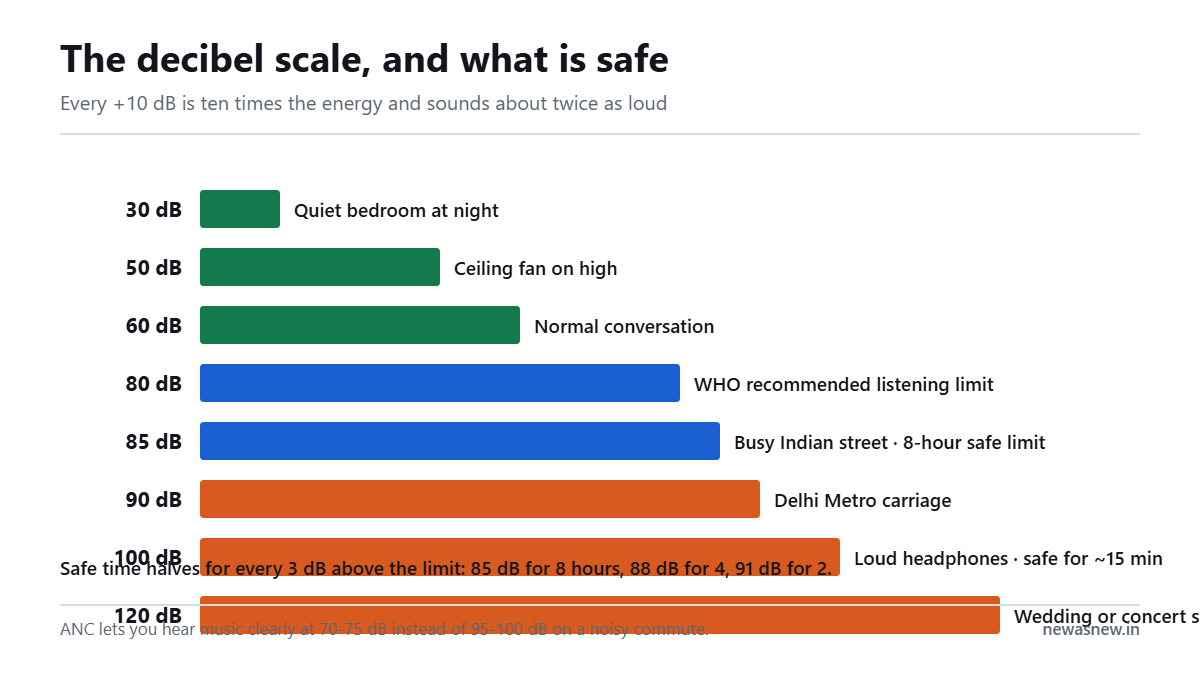
| Quiet bedroom at night | 30 dB | – |
| Normal conversation | 60 dB | – |
| Ceiling fan on high | 50-60 dB | Mostly low frequency, ANC handles it well |
| Busy Indian street | 80-90 dB | Horns push the peaks much higher |
| Delhi Metro carriage | 85-95 dB | ANC works well on the rumble, not the announcements |
| Aircraft cabin | 80-85 dB | The classic ANC use case |
| Wedding or concert speakers | 110-120 dB | Hearing damage territory within minutes |
The safe listening numbers you should actually know
Hearing damage is a function of level and time together. The widely used occupational guidance is 85 dB for 8 hours a day; the World Health Organization’s recommendation for recreational listening is stricter, around 80 dB for no more than 40 hours a week.
The rule that matters: for every 3 dB above the limit, safe time halves. 85 dB for 8 hours, 88 dB for 4 hours, 91 dB for 2 hours, 100 dB for about 15 minutes.
This is the strongest practical argument for buying ANC headphones, and it is a health argument rather than a luxury one. On a noisy commute without ANC, most people raise the volume until the music beats the noise — often to 95-100 dB. With ANC, the same perceived clarity arrives at 70-75 dB. Both iPhone and Android will show you your actual average listening level in their health or digital wellbeing settings. Check it once; most people are surprised.
What does dB mean in a headphone specification sheet?
Three different things, and they are routinely confused.
- Sensitivity, in dB/mW or dB/V. How loud the headphone gets for a given input. Around 100 dB/mW is easy to drive from a phone; below 95 dB/mW may sound quiet without an amplifier.
- Noise reduction, in dB. How much external sound is cut. Almost always the peak value at one low frequency, typically 100-300Hz.
- Signal-to-noise ratio, in dB. How far the music sits above the electronics’ own hiss. Higher is better; above 90 dB is fine.
When a listing says “35 dB noise cancellation”, assume it means the best single point on the curve. It is not wrong, but it tells you almost nothing about how the headphone handles a human voice at 1kHz — which for office users is the frequency that actually matters.
What should you look for instead of a big dB number?
- Hybrid ANC — microphones outside and inside the earcup. Better correction, fewer artefacts.
- Fit and seal. Passive isolation from a good seal supplies the high-frequency reduction ANC cannot. This is the single largest real-world variable.
- Adjustable ANC levels, so you can dial it back if strong cancellation gives you ear pressure.
- A real transparency mode, because you will need to hear traffic and announcements.
- Wind handling. Cheap feedforward ANC turns a breeze into a roar. If you ride two-wheelers or walk in open air, this matters more than any headline figure.
Who should NOT chase a high dB rating
- Office workers bothered by conversation. That sits at 500Hz-4kHz where ANC is weakest regardless of the number. Buy for seal and comfort instead.
- Anyone walking or cycling in traffic. You need to hear horns. Prioritise transparency mode.
- Anyone with a small ear canal buying earbuds. Get the fit right first. No dB figure survives a bad seal.
- Buyers under Rs 1,500 who care about sound quality. At that price, ANC is added at the expense of the driver. A good non-ANC pair will sound better.
What we can ship today
Every unit below is in stock as this page was last checked, with a 6-month NewAsNew Assured Warranty, GST invoice, 7-day returns and no-cost EMI. If it is listed here, we can dispatch it.
| Model | Price | MRP | You save |
|---|---|---|---|
| Apple iPhone 12 Mini Grade A Certified |
₹19,990 | ₹69,900 | 71% |
| Apple iPhone 14 Grade A Certified |
₹34,990 | ₹79,900 | 56% |
| Apple iPhone 15 Grade A Certified |
₹47,490 | ₹79,900 | 41% |
| Apple iPhone 15 Pro Max Grade A Certified |
₹79,990 | ₹159,900 | 50% |
Prices checked on 29 September 2026 — stock and prices move, so the linked product page is always the truth.
Browse all iPhones in stock · Ask us on WhatsApp which one fits you
Frequently asked questions
Is 30 dB noise cancellation good?
Yes, if it is measured honestly. 30 dB removes about 99.9% of sound energy at that frequency and sounds roughly one eighth as loud. But it is a peak figure at a low frequency, not an across-the-board reduction, so compare products by listening rather than by the number.
What is a safe dB level for headphones?
Common guidance is 85 dB for up to 8 hours, and the WHO recommends around 80 dB for no more than 40 hours a week for recreational listening. Above that, safe time halves for every 3 dB. Both iPhone and Android can show your measured average listening level.
Is 20 dB ANC enough for a flight?
For most people yes. Aircraft cabin noise is 80-85 dB and heavily low frequency, exactly where ANC performs best. 20 dB of reduction there is a very large subjective difference.
Does higher dB mean louder headphones?
Only when the specification is sensitivity, in dB/mW or dB/V. Higher sensitivity means more volume from the same phone output. A high noise-reduction dB figure means the opposite — more outside sound removed.
Why does my ANC headphone hiss?
A faint hiss is the noise floor of the ANC circuit itself, most audible in a very quiet room with no music playing. Better implementations keep it below the threshold of notice. If it is loud enough to bother you in normal use, that is a fault, and within our 7-day return window it is returnable.
Can ANC make a room completely silent?
No. It substantially reduces steady low-frequency noise and leaves most speech and sudden high-frequency sound largely intact. Anyone promising silence is overselling.
Related guides
- Unboxed headphones and earbuds: the full guide
- Sony vs Bose vs Sennheiser ANC compared
- Best unboxed noise-cancelling headphones
- What Active Noise Cancellation actually is
Still deciding? Talk to a human
Send us the work you do and your budget on WhatsApp and we will tell you honestly whether we have something for you — or whether you should wait. Chat with NewAsNew on WhatsApp (+91 79822 35917).
Browse live stock: Grade A Certified laptops · Refurbished iPhones · Unboxed headphones · Unboxed earbuds.
Written by Atul Pandey, co-founder of NewAsNew (NextG Serve Private Limited, New Delhi). We came from four years of offline electronics retail in Prayagraj before building NewAsNew. Only 2 to 3 out of every 10 devices that reach our QC bench pass; the other 7 to 8 go back to the supplier. The exact figure moves month to month with the stock we are offered, so we publish the range rather than one flattering number. Read our story.