Airpods & Earbuds (Unboxed)
  Camera & Lenses (Unboxed)
  Headphones (Unboxed)
  Laptops (Unboxed)
  MacBooks (Unboxed)
  Mobile Accessories (Unboxed)
  Monitors (Unboxed)
  Wearables (Unboxed)
  Laptops (Grade A)
  Monitors (Grade A)
  Smartphone (Grade A)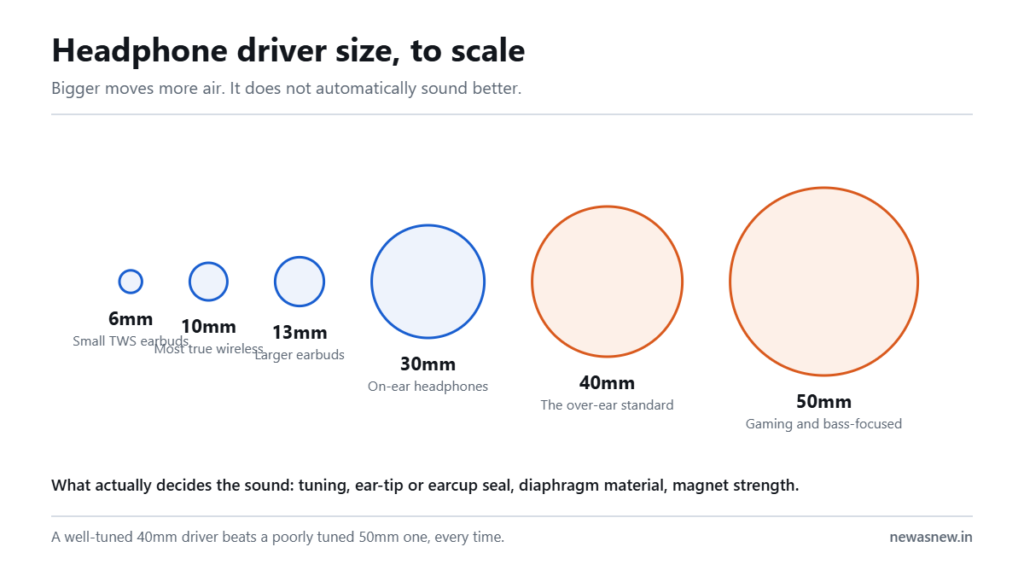
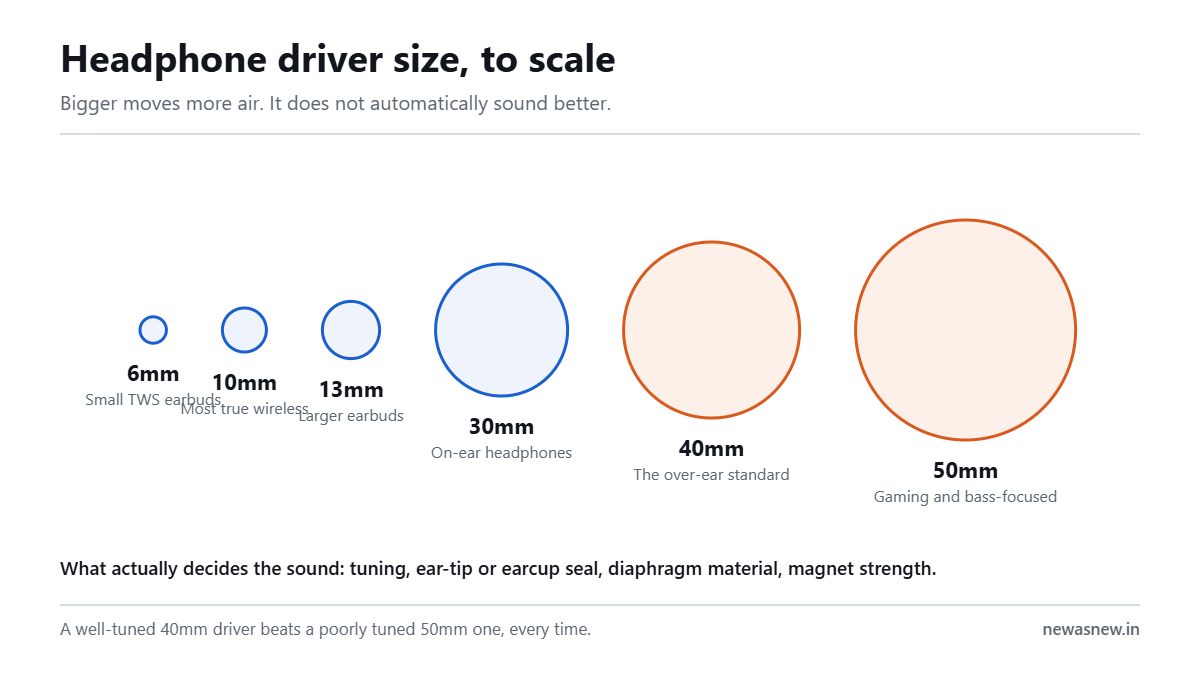
Short answer: Driver diameter tells you how much air the speaker can move, which sets the ceiling on bass and loudness, not the quality of what comes out. 6-10mm is normal in earbuds, 40mm is the standard for over-ear headphones, and 50mm is common but not automatically better. A well-tuned 40mm driver in a Sony WH-CH720N at Rs 5,890 will beat a poorly tuned 50mm driver every time. Tuning, seal and enclosure design decide how it sounds; the millimetre figure only decides what is possible.
Prices are live as of 6 September 2026 and move with stock — check the linked product page for the current figure before you decide.
What does driver size actually control?
Sound is moved air. A larger diaphragm displaces more air per movement, which means it can produce low frequencies at higher volume without straining.
That is genuinely all the number tells you. It sets a physical ceiling. Whether the headphone gets anywhere near that ceiling, and whether the result sounds good, is decided by other things entirely.
| Size | Where you find it | What to expect |
|---|---|---|
| 6-8mm | Small TWS earbuds, some in-ear monitors | Adequate bass with a good seal; limited at high volume |
| 10-13mm | Most true wireless earbuds | The mainstream sweet spot for in-ear |
| 14-16mm | Larger earbuds, some neckbands | More bass headroom; bulkier housing |
| 30-32mm | On-ear headphones | Compact; less bass extension than over-ear |
| 40mm | The over-ear standard | Well-understood, easy to tune well |
| 50mm | Gaming and bass-focused over-ear | More headroom, heavier, harder to control |
Why is bigger not automatically better?
Three reasons, and they are the reasons a 50mm gaming headset can sound worse than a 40mm Sony.
A bigger diaphragm is heavier. More mass means more inertia, which makes it harder to start and stop quickly. Slow starting and stopping is heard as muddy, smeared detail — especially in the treble.
Bigger diaphragms flex. A large thin membrane does not move as one piece; different parts move at slightly different times. That causes distortion, and controlling it needs better materials and stronger magnets, which cost money.
The enclosure matters as much as the driver. How air behind the driver is vented or trapped shapes the bass response profoundly. A 40mm driver in a well-designed sealed cup will produce deeper, cleaner bass than a 50mm driver in a badly vented one.
What actually decides how a headphone sounds?
- Tuning. The frequency response the engineers chose. This is the single biggest factor and it never appears on a spec sheet. It is why brands with long tuning experience — Sony, Sennheiser, Bose — sound consistent across price points.
- Seal and fit. For earbuds, the ear tip. For over-ear, the pad material and clamping force. A broken seal removes bass entirely, no matter the driver size.
- Diaphragm material. PET is standard; titanium-coated, LCP and beryllium-coated diaphragms are stiffer and lighter, which controls the flexing problem above.
- Magnet strength. A stronger motor controls the diaphragm better. Neodymium is standard; the grade varies enormously and is rarely disclosed.
- Amplification. Sensitivity, quoted in dB/mW, tells you whether your phone can drive the headphone to a proper volume. Below about 95 dB/mW, a phone may struggle.
Is a 50mm gaming headset better for gaming?
Not for the reason it is sold on. Competitive gaming needs accurate positional imaging — hearing where a footstep came from — and that depends on a flat, controlled response and good channel matching, not on diaphragm area. Many 50mm gaming headsets are tuned with exaggerated bass, which actively masks the footstep cues players are listening for.
If positional accuracy is your goal, a neutral 40mm headphone often serves better than a bass-heavy 50mm one.
Who should NOT choose on driver size
- Anyone comparing across form factors. A 10mm earbud and a 40mm over-ear are not comparable. Different air volume, different seal, different physics.
- Anyone buying for calls or podcasts. Speech sits in the midrange, which almost every driver handles adequately. Microphone quality matters far more.
- Anyone with a poor seal. Fix the fit first. It changes bass more than doubling driver size would.
- Bass lovers assuming more mm means more thump. Tuning and enclosure decide this. Some 10mm earbuds have far more bass than some 40mm headphones.
Live unboxed stock across the sizes
| Model | Price | Form |
|---|---|---|
| boAt Rockerz 330 neckband | Rs 699 | In-ear neckband |
| realme Buds Air 5 | Rs 1,490 | True wireless in-ear |
| Sony WH-CH520 | Rs 2,490 | On-ear |
| Sony WF-C510 | Rs 2,990 | True wireless in-ear |
| Skullcandy Hesh ANC | Rs 3,690 | Over-ear |
| JBL Tune 770NC | Rs 4,490 | Over-ear ANC |
| Sony WH-CH720N | Rs 5,890 | Over-ear ANC |
| Sennheiser ACCENTUM | Rs 8,890 | Over-ear |
| Bose QuietComfort | Rs 11,490 | Over-ear ANC |
What we can ship today
Every unit below is in stock as this page was last checked, with a 6-month NewAsNew Assured Warranty, GST invoice, 7-day returns and no-cost EMI. If it is listed here, we can dispatch it.
| Model | Price | MRP | You save |
|---|---|---|---|
| Apple iPhone 12 Mini Grade A Certified |
₹19,990 | ₹69,900 | 71% |
| Apple iPhone 14 Grade A Certified |
₹34,990 | ₹79,900 | 56% |
| Apple iPhone 15 Grade A Certified |
₹47,490 | ₹79,900 | 41% |
| Apple iPhone 15 Pro Max Grade A Certified |
₹79,990 | ₹159,900 | 50% |
Prices checked on 29 September 2026 — stock and prices move, so the linked product page is always the truth.
Browse all iPhones in stock · Ask us on WhatsApp which one fits you
Frequently asked questions
Is a bigger headphone driver better?
Not by itself. A larger driver can move more air, raising the ceiling for bass and volume, but it is also heavier and harder to control. Tuning, diaphragm material and enclosure design determine the actual sound quality.
What is a good driver size for earbuds?
10mm to 13mm is the mainstream range and works well. 6mm to 8mm designs can sound excellent with a good seal and careful tuning; they simply have less headroom at high volume.
Is 40mm or 50mm better for over-ear headphones?
40mm is the standard because it is the easiest size to tune well. 50mm offers more headroom but demands better materials and magnets to control. Well-executed 40mm beats mediocre 50mm consistently.
Does driver size affect volume?
Indirectly. Sensitivity, measured in dB/mW, determines volume for a given input. Larger drivers often have higher sensitivity, but not always — check the sensitivity figure rather than the diameter.
Why do my earbuds have no bass?
Almost always the seal. Try a larger ear tip. If a light push into the ear canal suddenly brings the bass back, your tips are too small. This is the most common and most fixable audio complaint we hear.
Does driver size matter for gaming headsets?
Less than tuning does. Positional accuracy depends on a controlled, reasonably flat response and matched channels. Exaggerated bass, common in large-driver gaming headsets, can actually make footsteps harder to locate.
Related guides
- Unboxed headphones and earbuds: the full guide
- Sony vs Bose vs Sennheiser ANC compared
- Best unboxed noise-cancelling headphones
- What Active Noise Cancellation actually is
Still deciding? Talk to a human
Send us the work you do and your budget on WhatsApp and we will tell you honestly whether we have something for you — or whether you should wait. Chat with NewAsNew on WhatsApp (+91 79822 35917).
Browse live stock: Grade A Certified laptops · Refurbished iPhones · Unboxed headphones · Unboxed earbuds.
Written by Atul Pandey, co-founder of NewAsNew (NextG Serve Private Limited, New Delhi). We came from four years of offline electronics retail in Prayagraj before building NewAsNew. Only 2 to 3 out of every 10 devices that reach our QC bench pass; the other 7 to 8 go back to the supplier. The exact figure moves month to month with the stock we are offered, so we publish the range rather than one flattering number. Read our story.