 Airpods & Earbuds (Unboxed)
  Camera & Lenses (Unboxed)
  Headphones (Unboxed)
  Laptops (Unboxed)
  MacBooks (Unboxed)
  Mobile Accessories (Unboxed)
  Monitors (Unboxed)
  Wearables (Unboxed)
  Laptops (Grade A)
  Monitors (Grade A)
  Smartphone (Grade A)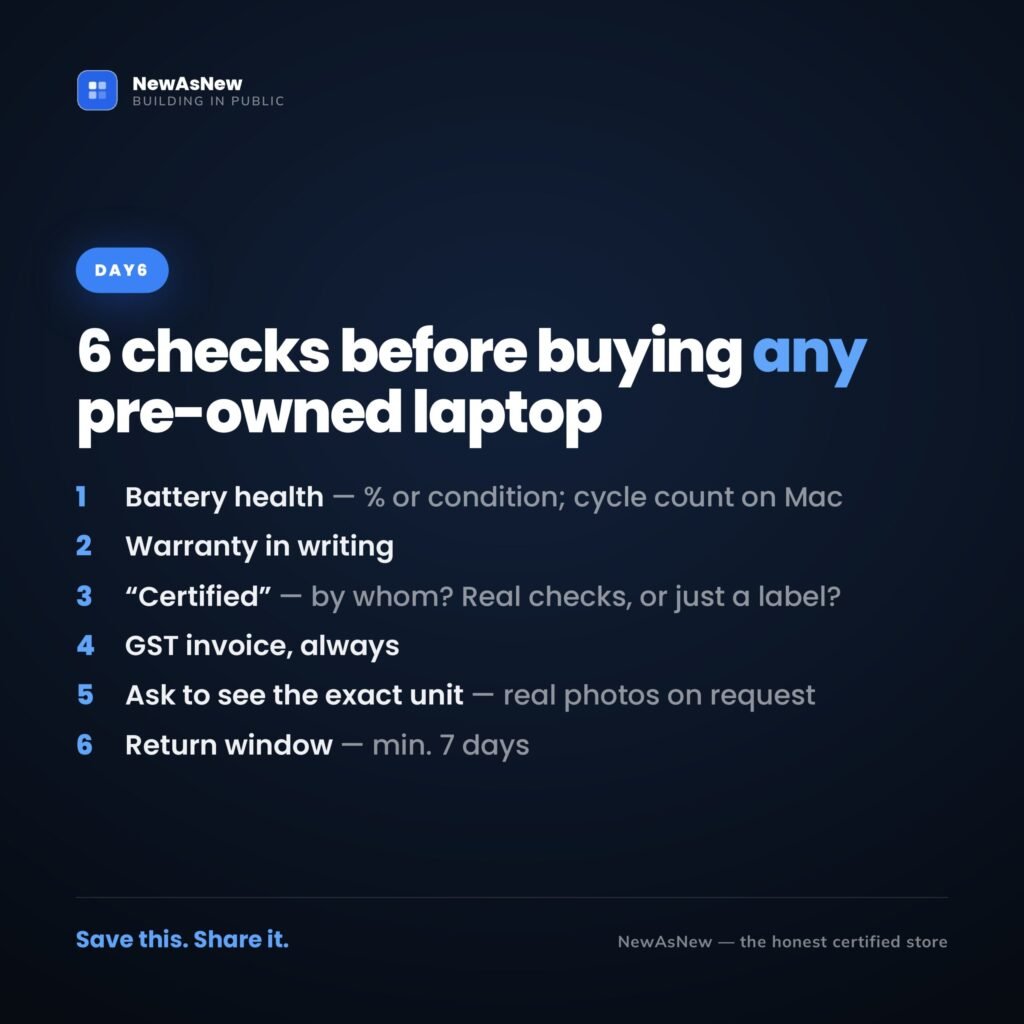
Short answer: A refurbished laptop is safe to buy in India if the seller gives you three things in writing — a written warranty, a GST invoice in the company’s name, and a clear return window — and can tell you the exact battery health and what their “certification” actually checked. If any of those are missing, walk away. This guide shows you the 6 checks that separate an honest deal from a costly mistake.
What “Excellent” battery health means here: above 80% of original design capacity on a laptop, and above 85% on a smartphone. The thresholds differ because the two age differently — a laptop spends most of its life on mains power, a phone is cycled every day. Anything below that is not listed; there is no lower battery tier. The measured figure for your exact unit is printed on its product page.
I run NewAsNew, a certified refurbished electronics store in India, and I built it after watching too many students and first-time buyers get cheated on “certified” laptops that were anything but. So this guide isn’t a sales pitch. It’s the exact checklist I’d want my own family to use — even if they buy from someone else.
What does “refurbished laptop” actually mean?
A refurbished laptop is a used or returned laptop that has been inspected, repaired if needed, cleaned, tested, and re-sold with a warranty. It is not the same as a random second-hand laptop sold “as-is” by a stranger.
The problem in India is that “refurbished” and “certified” are unregulated words. Anyone can print them. What matters is not the label but what was actually tested and what protection you get after you pay. That’s why every check below is about proof, not promises.
Is it safe to buy a refurbished laptop in India?
Yes — a refurbished laptop is safe to buy in India when it comes with a written warranty, a GST invoice, and a return window. Those three things mean that if something goes wrong, you have a legal, practical way to fix it or get your money back.
It becomes risky only when you buy from a seller who offers none of that — no bill, no warranty, “no returns,” and only a WhatsApp promise. In that case you’re not buying a refurbished laptop, you’re buying someone else’s problem with no safety net.
A good refurbished laptop can save you 30–50% versus a brand-new one and still perform like new for years. The saving is real. The only thing you need to protect is the trust — and that’s exactly what the checklist below does.
Refurbished vs second-hand vs unboxed: what’s the difference?
These three terms get mixed up constantly, and that confusion is where buyers overpay. Here’s the honest difference:
| Type | What it means | Condition | Warranty? | Best for |
|---|---|---|---|---|
| Unboxed / Open-box | Brand new, box opened but barely or never used (a return, display piece, or overstock) | Like-new | Usually yes | Buyers who want near-new at a discount |
| Refurbished (Grade A / Certified) | Used, then professionally inspected, restored and tested | Excellent, lightly used | Yes (from a real seller) | Best value-for-money buyers |
| Second-hand / Used | Sold as-is by the previous owner, no testing | Unknown — buyer beware | Almost never | Only if you can test it yourself and accept the risk |
The honest takeaway: “Unboxed” should cost the most and “second-hand” the least. If a plain second-hand laptop is priced like a certified refurbished one, you’re overpaying for the word, not the product.
(At NewAsNew we sell only two of these — Unboxed and Grade A Certified — because they’re the only two we can stand behind with a warranty. We don’t touch untested second-hand stock.)
What does “certified refurbished” really mean in India?
Here’s the uncomfortable truth: in India, “certified” on its own means almost nothing. There is no single government body that certifies refurbished laptops. So “certified” is only as trustworthy as the seller behind it.
That’s not a reason to avoid refurbished laptops — it’s a reason to ask one question: “Certified by whom, and against what checklist?”
An honest seller will answer instantly and specifically. For example, at NewAsNew every laptop goes through a 50-point quality check covering the battery, screen, keyboard, ports, storage health, thermals, hinges and more — and if a unit fails, it doesn’t get sold. If a seller can’t tell you what their certification checked, treat the word as marketing, not proof.
The 6 things to check before buying ANY refurbished laptop
Use this checklist with any seller in India — us or anyone else. It’s the fastest way to tell an honest deal from a trap.
1. Battery health — as a number, not a promise. Ask for the actual battery health percentage or charge-cycle count. “Battery is good” is not data. Below ~80% health, either walk away or demand a discount, because you’ll be replacing it soon.
2. Warranty — in writing. Not a verbal “don’t worry, warranty hai.” A real written warranty with a stated period and a clear claim process. No written warranty means no real protection.
3. “Certified” — by whom? Ask what the certification actually checked and how many points. A specific answer (a real QC checklist) is trust. A vague one is a red flag.
4. GST invoice — always. Insist on a proper GST invoice in the seller’s registered company name. This is your legal proof of purchase and the thing that makes a warranty claim or return actually enforceable. No bill = no recourse.
5. Ask to see the exact unit. A genuine seller will happily send you real photos or a short video of the exact laptop you’ll receive — screen on, keyboard, ports, and battery report. If they only show catalog images and dodge the request, that tells you something.
6. Return window — at least 7 days. Even a 7-day return window is enough to test everything at home. “All sales final” on a used laptop is a billboard-sized warning. A seller confident in their product isn’t scared of returns.
Save this list. If a laptop passes all six, you’re buying from someone honest. If it fails even two, keep looking.
How much should a refurbished laptop cost in India?
Prices move with the model and configuration, but as a rough guide for 2026, a solid refurbished laptop for a student, freelancer or work-from-home user typically lands in the ₹20,000–₹50,000 range — often 30–50% below the equivalent new machine.
At that price you should reasonably expect a recent-generation Intel Core i5 (or equivalent), 8–16GB RAM, and an SSD. Two money-saving tips:
- Judge the processor generation, not just the name. A 4-year-old Core i5 can be slower than a newer Core i3. Check the generation before you compare prices.
- Use no-cost or low-cost EMI to shrink the number. A ₹30,000 laptop framed as roughly ₹2,500/month feels far more affordable — most honest refurbished sellers in India offer EMI, so ask.
Refurbished laptops for students and work-from-home
For students, freelancers, and WFH professionals, a certified refurbished laptop is often the smartest buy in the market — you get near-new performance for browsing, MS Office, coding, classes, Zoom calls and light design work at a fraction of the new price. The money you save can go toward RAM, a bag, or simply staying within budget.
The only rule: buy the certified/Grade-A kind with warranty and a bill, not an untested second-hand unit. The whole point is to save money without inheriting risk.
Red flags: when to walk away
Some warnings are worth memorising. Walk away if a seller:
- Won’t give a GST invoice or offers only a hand-written slip.
- Says “no returns” on a used laptop.
- Can’t tell you the battery health as a number.
- Uses only stock photos and refuses to show the actual unit.
- Prices a plain second-hand unit like a certified one.
- Pressures you to pay fast “before it’s gone” instead of answering your questions.
Honesty is patient. Pressure is a tactic.
Why warranty and a GST invoice matter more than the price
It’s tempting to chase the lowest price. But on a refurbished laptop, the warranty and the GST invoice are what you’re really paying for — they’re the difference between a great deal and a gamble.
A slightly higher price with a written warranty, a GST bill, and a 7-day return is almost always cheaper in the long run than a rock-bottom price with none of them. Because the day something goes wrong, the paperwork is what saves you — not the discount.
Frequently asked questions
Is it safe to buy a refurbished laptop in India?
Yes, as long as it comes with a written warranty, a GST invoice in the seller’s company name, and a return window of at least 7 days. Those protections make a refurbished laptop a safe, money-saving choice. Avoid untested second-hand units sold with no bill or warranty.
What is the difference between refurbished and second-hand?
A refurbished laptop is professionally inspected, restored, tested, and sold with a warranty. A second-hand laptop is sold as-is by the previous owner with no testing and usually no warranty. Refurbished is the safer choice for most buyers.
Does “certified refurbished” mean anything in India?
There is no single government certification for refurbished laptops in India, so “certified” is only as reliable as the seller. Always ask what the certification actually checked — for example, a defined multi-point quality inspection — before trusting the label.
How much can I save buying a refurbished laptop?
Typically 30–50% versus the same model bought new, depending on the age and condition. A student-grade refurbished laptop in India commonly falls in the ₹20,000–₹50,000 range in 2026.
How do I check a refurbished laptop’s battery health?
Ask the seller for the battery health percentage or charge-cycle count in writing. On Windows you can run a battery report (the powercfg /batteryreport command); on a Mac, check System Information → Power. Anything above roughly 80% health is generally healthy.
Can I get an EMI on a refurbished laptop?
Yes — most established refurbished sellers in India offer EMI, including no-cost EMI options, which can bring a ₹30,000 laptop down to roughly ₹2,500 per month. Ask the seller before you buy.
The honest bottom line
A refurbished laptop is one of the smartest ways to buy well in India — if you buy on proof, not promises. Run the 6 checks, insist on a warranty and a GST invoice, and you’ll get near-new performance while keeping your money safe.
That’s the standard I hold my own store to. At NewAsNew, every laptop passes a 50-point quality check and ships with a written warranty, a GST invoice, 7-day returns, and — if you ask — real photos of your exact unit before you pay. Not every product deserves to be sold, so the ones that don’t qualify never get listed.
👉 Browse honestly-graded refurbished laptops at NewAsNew →
See the checklist in action
Every laptop we list went through the same 50-point check this guide describes. Open any live listing and you can verify each point yourself — condition grade, warranty, 7-day returns and GST invoice: