Airpods & Earbuds (Unboxed)
  Camera & Lenses (Unboxed)
  Headphones (Unboxed)
  Laptops (Unboxed)
  MacBooks (Unboxed)
  Mobile Accessories (Unboxed)
  Monitors (Unboxed)
  Wearables (Unboxed)
  Laptops (Grade A)
  Monitors (Grade A)
  Smartphone (Grade A)
 Short answer: Unboxed electronics come from five places: customer returns made inside marketplace return windows, retail display and demo units, cancelled or refused deliveries, surplus stock when a newer model launches, and corporate lease returns. Once a sealed carton is opened, the unit can no longer legally be represented as new — so it leaves the primary channel at a discount. That discount is a packaging technicality, not a statement about the product. A Sony WF-C510 at ₹2,990 or a Nikon NIKKOR Z 40mm f/2 at ₹18,990 is the same hardware either way.
Prices are live as of 16 August 2026 and move with stock — check the linked product page for today’s exact price.
The question behind the question
When someone asks where unboxed stock comes from, they are usually asking something else: is this stolen, faulty, or a lie? It is a fair question, and the industry has earned the suspicion by being vague. Here is the actual answer, in order of how much of it we see.
| Source | What it is | Typical condition | How we grade it |
|---|---|---|---|
| Customer returns | Returned inside a marketplace return window | Box opened, product usually unused | Unboxed |
| Retail display units | Demo pieces from a shop floor | Handled, powered on, low usage | Unboxed or Grade A, case by case |
| Cancelled deliveries | Refused at the door or undeliverable | Never opened by a customer | Unboxed |
| Surplus and end-of-line | Unsold stock when a new model launches | Unused, older model year | Unboxed |
| Corporate lease returns | Fleet machines off a three-year lease | Genuinely used, then restored | Grade A Certified |
1. Customer returns — by far the largest source
Most of the unboxed stock that reaches us is a product someone bought, opened, and sent back inside the return window. What surprises people is how rarely the reason has anything to do with the product working.
The reasons we see repeatedly: the colour looked different on screen; it was a gift and the recipient already owned one; two family members ordered the same thing; a newer model launched days later; it arrived after the occasion it was bought for; someone changed their mind in the twenty minutes between ordering and delivery.
None of those are defects. But the moment that carton comes back, the unit cannot re-enter the shelf as new — which is the entire economic engine of this market. A functional device becomes a discounted device because of what happened to its packaging, not to it. A smaller share of returns genuinely are faulty, and separating those out is the whole job. “We buy returns” is only an acceptable answer if the next sentence explains what gets rejected.
2. Retail display and demo units
Every phone, laptop, monitor and pair of headphones on a shop floor is a working unit that customers pick up, press and put down. When a store rotates its display, refits or drops a line, those pieces come out.
This is the category that most deserves case-by-case honesty. A monitor switched on in a showroom for months has accumulated real panel hours. Binoculars on a counter have been handled but not worn out. A laptop demo unit may have hundreds of hours on the battery. We grade these individually — some go out as Unboxed, some as Grade A Certified, and some do not go out at all.
3. Cancelled and refused deliveries
A parcel refused at the door, undeliverable because the address failed, or cancelled in transit goes back to the seller. Often nobody ever opened it — but its packaging has been through the courier network twice and its chain of custody is broken. With cash-on-delivery orders, still common across much of India, refusals are more frequent than on prepaid. This is a large and genuinely clean source of stock.
4. Surplus and end-of-line stock
When a manufacturer launches a new model, the previous one stops selling at its old price almost overnight, leaving distributors holding inventory that is brand new, entirely unused and suddenly hard to move. Some is discounted through the primary channel and some is released into the secondary market. An end-of-line unit is often the best value in this entire supply chain: never opened, never powered on, simply on the wrong side of a product launch.
5. Corporate lease returns — and why these are not “unboxed”
Large organisations do not buy laptops, they lease fleets and replace them every three years. At the end of a lease, hundreds of identical Dell Latitude, HP EliteBook and Lenovo ThinkPad machines enter the secondary market at once.
These are genuinely used — somebody typed on that keyboard every working day for three years. Calling them unboxed would be a lie, so we do not. They are cleaned, tested, have worn parts replaced, and are listed as Grade A Certified with a 6-month NewAsNew Assured warranty. A Dell Latitude 7490 Core i5 at ₹22,490 is honest about being a restored business machine, and that restoration is why corporate laptops make the best refurbished buys.
This distinction is the most important thing on our site. Unboxed: box opened, product unused. Grade A: product used, professionally restored. The boundary is set out in our unboxed vs refurbished vs new guide.
Why this stock cannot be sold as new again
This is the part most buyers have never had explained, and it is the key to everything.
“New” is not a description of condition. It is a claim about history — that the product came directly from the manufacturer to you, sealed, with nobody in between opening it. Once the seal is broken that claim is untrue, and calling it new anyway would misrepresent it to the buyer under the consumer protection principles that apply to any seller in India.
So a retailer holding an opened but perfectly functional unit has two honest options: sell it at a discount with the truth attached, or write it off. The discount is not compensation for a defect. It is the price of a broken seal.
That changes how you should shop. The right question is never “why is it cheaper?” — the answer is always the same and it is boring. The right question is “how do you know this particular unit is fine?” Every seller should be made to answer it.
What happens to a unit before you see it
Every unit that arrives here goes through the same sequence before it is allowed near a listing.
- Intake and identification. Serial number recorded, model and configuration confirmed against what was declared.
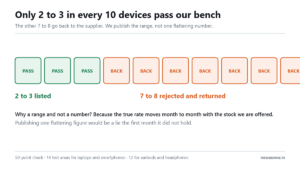
- The 50-point quality check. Function, ports, display, audio, battery, mechanicals and cosmetics, documented per unit. The full list is in our 50-point quality check explained.
- Measurement, not adjectives. Battery health is recorded as a measured band and stated on the listing. We do not write “battery is good” because that is not a measurement.
- Grading. Unboxed or Grade A Certified, decided by evidence rather than by what would sell faster.
- Rejection. Units that fail go back or go to parts. They do not get relabelled into a lower grade to recover the cost.
What we refuse to list
“Not every product deserves to be sold” is not a slogan for us, it is an operating cost. Things that do not make it to the site:
- Units that fail any functional point of the quality check
- Devices with a serial that cannot be verified, or activation locks that cannot be cleared by the rightful owner
- Batteries below our minimum health threshold, unless the unit is repriced with the measured figure stated openly
- Anything with liquid ingress markers triggered, at any price
- Cosmetically fine units with intermittent faults we cannot reproduce reliably — an intermittent fault is still a fault
Why we grade honestly
In 2022 our founder bought a gadget online in India and was cheated. Not dramatically — the ordinary version that happens to thousands of people every week. The listing said one thing, the box arrived saying another, the seller stopped replying, and there was no invoice worth the name to argue with.
NewAsNew exists because of that transaction. The company had been selling electronics in Prayagraj as The Next G since 2020, and moved into unboxed and refurbished in 2022 with one rule carried over: describe the unit as it is, in writing, before the money changes hands. NextG Serve Pvt. Ltd. was incorporated in New Delhi in 2024 to do it at scale — the full version is in our story. It is also why every order carries a GST invoice, why there is a 7-day return window, and why battery health appears as a number rather than a compliment.
Who should not buy from this supply chain
- You need a sealed retail box. If the packaging matters — for a gift, or for a corporate asset audit that requires factory seals — buy new.
- You want the current model on launch day. This market runs behind the release cycle by design. Surplus stock exists precisely because something newer arrived.
- You want the full manufacturer warranty period. Unboxed units carry the remaining original warranty, up to 12 months, not a fresh term from your purchase date.
- You will not check the listing carefully. The grade, the battery band and the condition notes are the product. If you buy without reading them, you have thrown away the protection they give you.
What we can ship today
Every unit below is in stock as this page was last checked, with a 6-month NewAsNew Assured Warranty, GST invoice, 7-day returns and no-cost EMI. If it is listed here, we can dispatch it.
| Model | Price | MRP | You save |
|---|---|---|---|
| Dell Latitude 7490 Intel Core i5 8th Gen Laptop · Business Series |
₹22,490 | ₹88,999 | 75% |
| Dell Latitude 5400 Core i7 8th Gen Laptop · Business Series |
₹25,990 | ₹79,999 | 68% |
| Dell Latitude 5310 2-in-1 Core i5 10th Gen Laptop · 360° Convertible · Business Series |
₹39,990 | ₹89,000 | 55% |
| Dell Precision 3551 Core i7 10th Gen Laptop · 4GB Graphics · Mobile Workstation |
₹54,990 | ₹149,999 | 63% |
Prices checked on 29 September 2026 — stock and prices move, so the linked product page is always the truth.
Browse all laptops in stock · Ask us on WhatsApp which one fits you
Frequently asked questions
Where do unboxed electronics actually come from?
From five sources: customer returns made inside marketplace return windows, retail display and demo units, cancelled or refused deliveries, surplus stock left over when a newer model launches, and corporate lease returns. Customer returns are by far the largest source, and most of those returns happen for reasons unconnected to the product working — wrong colour, changed mind, duplicate gift.
Why can’t opened electronics be sold as new?
Because “new” is a claim about history rather than condition — that the product came sealed from the manufacturer with nobody in between opening it. Once the seal is broken that claim is untrue, and describing it as new would misrepresent it to the buyer. The seller’s honest options are to discount it with the truth attached or write it off, which is why the discount exists.
Are unboxed products faulty returns?
Mostly not. The majority of returns in this supply chain are for non-product reasons: the colour looked different online, it was a duplicate gift, the buyer changed their mind, a newer model launched. Genuinely faulty returns do enter the stream, and separating them out is precisely what a quality check is for. Any seller who cannot tell you what they reject is not doing that work.
What is the difference between unboxed and Grade A Certified?
Unboxed means the retail box was opened but the product was never put into service — a return, a display piece or surplus stock. Grade A Certified means the product was genuinely used, usually a corporate lease return, and has been professionally cleaned, tested and restored. Unboxed units carry remaining brand warranty; Grade A units carry our 6-month NewAsNew Assured warranty.
Is buying unboxed electronics safe in India?
Yes, provided the seller is accountable and specific. Insist on three things: a stated grade with condition notes, a GST invoice in your name, and a written return window. A seller who gives you all three has something to lose if the unit is wrong. One who avoids any of them does not, and no discount compensates for that.
Are unboxed electronics stolen or grey market goods?
Not in a legitimate supply chain. Returns, display units, refused deliveries and end-of-line surplus all move through documented commercial channels, which is why a GST invoice can be issued at the end of it. Serial numbers are recorded at intake, and units whose provenance cannot be verified are refused rather than listed. If a seller cannot invoice you properly, ask why.
Does unboxed stock come with a warranty in India?
Yes. Unboxed units carry the remaining original brand warranty where the manufacturer’s coverage is still valid, up to 12 months. Grade A Certified units carry a 6-month NewAsNew Assured warranty. Both come with 7-day returns and a GST invoice. Batteries, physical damage and liquid damage are excluded, as they are under manufacturer warranties everywhere.
The honest bottom line
The open-box supply chain is neither mysterious nor shameful. It is what happens when a retail system gives customers the right to change their mind, and then has to do something responsible with the perfectly good products that come back. The discount is the price of a broken seal, nothing more.
What separates a good seller from a bad one here is not where the stock comes from — everyone draws from the same pool. It is what they refuse to list, and whether they will write down in advance exactly what you are getting. Judge us on that, and judge everyone else on it too. For the reasoning applied to categories, unboxed camera lenses is where the logic is strongest and unboxed mobile accessories is where we tell you what not to buy.
Browse current stock: Unboxed laptops · Grade A Certified laptops · All products
Still deciding? Message us on WhatsApp (+91 79822 35917) with your budget and how you will use it, and we will tell you honestly whether this is the right pick for you.
Written by the NewAsNew team — NextG Serve Pvt. Ltd., New Delhi. We have been selling electronics since 2020 and refurbished and unboxed devices since 2022. Read our story.