Airpods & Earbuds (Unboxed)
  Camera & Lenses (Unboxed)
  Headphones (Unboxed)
  Laptops (Unboxed)
  MacBooks (Unboxed)
  Mobile Accessories (Unboxed)
  Monitors (Unboxed)
  Wearables (Unboxed)
  Laptops (Grade A)
  Monitors (Grade A)
  Smartphone (Grade A)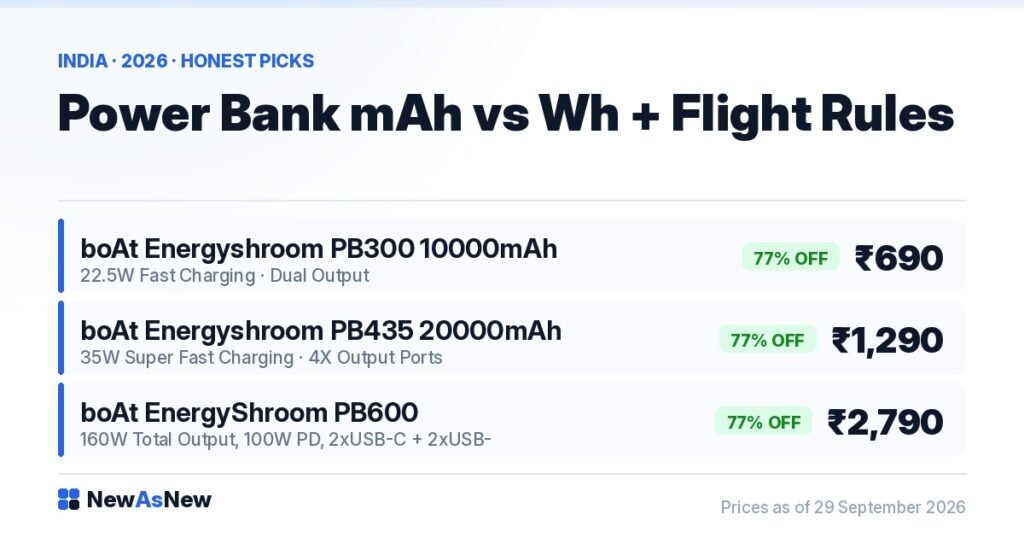
Short answer: Watt-hours = (mAh ÷ 1000) × 3.7, because power bank cells sit at a nominal 3.7V. So a 20,000mAh bank such as the boAt Energyshroom PB435 at ₹1,290 is about 74Wh — comfortably under the 100Wh airline limit and allowed in cabin baggage on Indian flights. A 30,000mAh bank is about 111Wh and needs airline approval. Power banks must never go into checked baggage, at any capacity.
Prices are live as of 29 September 2026 and move with stock — check the linked product page for today’s exact price.
Why is a power bank sold in mAh but regulated in Wh?
Because mAh on its own is meaningless. Milliampere-hours measure charge, not energy. To get energy you have to multiply charge by voltage.
Aviation rules care about energy, because energy is what a battery releases if it fails. So every airline and every regulator, including India’s DGCA, works in watt-hours.
The formula is simple:
Wh = (mAh ÷ 1000) × nominal cell voltage
For almost every lithium-ion power bank sold in India, that nominal cell voltage is 3.7V. Some lithium-polymer packs are quoted at 3.8V or 3.85V, which changes the answer by two or three percent — not enough to move you across a limit.
What is the mistake nearly everyone makes with this calculation?
They use 5V instead of 3.7V.
It is an easy mistake. USB output is 5V, so people assume the battery is a 5V battery. It is not. The cells inside are 3.7V and a converter steps that up to 5V, 9V, 15V or 20V on the way out.
Use 5V and a 20,000mAh bank looks like 100Wh — right on the airline threshold, and you will talk yourself out of a perfectly legal purchase. Use 3.7V and the real figure is 74Wh, which is clearly fine.
The number that counts is the one printed on the body of the unit. Every compliant power bank has its Wh rating moulded or printed on the casing, and that printed figure is what a security officer reads. If a unit has no printed Wh rating, that is a reason not to fly with it and honestly a reason not to own it.
What are the actual rules on Indian flights?
Three bands, and they are consistent across Indian carriers:
| Energy rating | Status on Indian flights | Baggage | Example capacity at 3.7V |
|---|---|---|---|
| Under 100Wh | Generally allowed, no approval needed | Cabin only | Up to about 27,000mAh |
| 100Wh to 160Wh | Usually needs prior airline approval; typically limited to two units | Cabin only | About 27,000mAh to 43,000mAh |
| Over 160Wh | Not permitted as passenger baggage | Neither cabin nor checked | Above about 43,000mAh |
Two rules apply to every band, with no exceptions worth arguing about at a boarding gate:
Power banks go in cabin baggage, never in checked baggage. A battery in the hold is a fire nobody can reach. If your bag is gate-checked, take the power bank out and carry it with you.
Terminals must be protected and the unit must not be loose among metal objects. Keep it in a pouch or its own pocket, not rattling against keys and coins.
Many Indian carriers also now ask that power banks are not used or charged during the flight. That is an in-cabin usage rule, separate from whether you may carry it. Follow the crew.
Which of our power banks are cabin-legal?
Clearly under the limit — no approval needed:
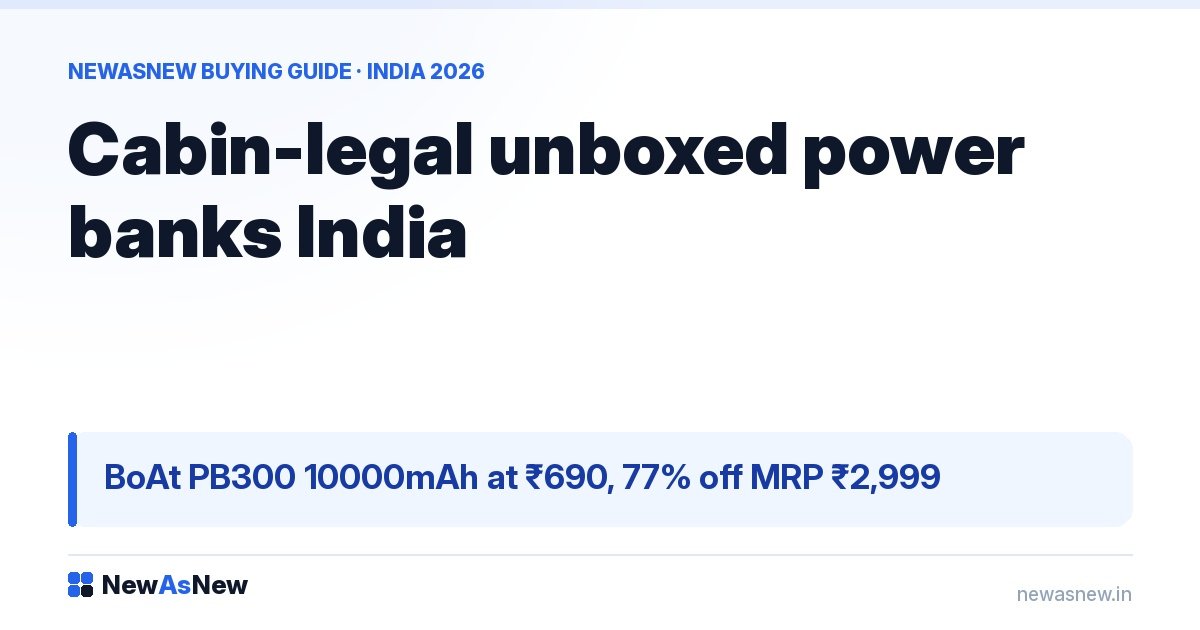
boAt Energyshroom PB300 10000mAh, 22.5W — ₹690 (Unboxed, MRP ₹2,999, 77% off). About 37Wh. Nothing to think about at security. This is the one to buy if you fly often and only need a phone top-up.
boAt Energyshroom PB435 20000mAh, 35W, 4 ports — ₹1,290 (Unboxed, MRP ₹5,499, 77% off). About 74Wh. This is the sweet spot for Indian travel: a full day of charging for two people, still 26Wh below the threshold.
Right at the line — read the printed label before you fly:
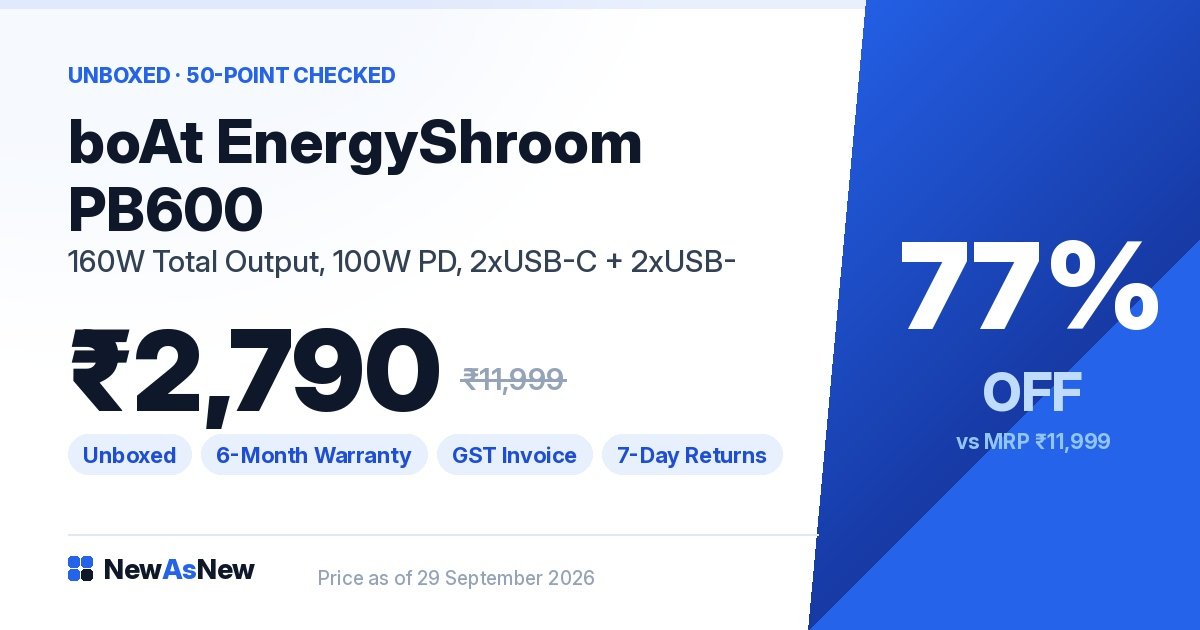
boAt EnergyShroom PB600 PowerPulse 27000mAh, 160W total output — ₹2,790 (Unboxed, MRP ₹11,999, 77% off). At 3.7V this works out to roughly 99.9Wh — technically inside the 100Wh band, but with no margin. Check the Wh figure printed on your specific unit and do not assume. If it prints above 100Wh, treat it as needing approval. Note that the 160W in the name is output power, not energy; it has no bearing on the airline limit.
Above the line — needs airline approval:
boAt EnergyShroom PB665 Turbo X 30000mAh, 65W — ₹3,290 (Unboxed, MRP ₹9,999, 67% off). About 111Wh. Excellent power bank, genuinely good for charging a 14-inch business laptop on a train or a shoot — the kind of machine in our under ₹25,000 laptop picks. It is the wrong buy if your main use is flying, and we would rather tell you that before you order it than after it is refused at a gate.
How do I work out my own bank’s rating in ten seconds?
Divide the mAh by 1,000 and multiply by 3.7. That is it.
10,000 ÷ 1,000 = 10, × 3.7 = 37Wh.
20,000 ÷ 1,000 = 20, × 3.7 = 74Wh.
27,000 ÷ 1,000 = 27, × 3.7 = 99.9Wh.
30,000 ÷ 1,000 = 30, × 3.7 = 111Wh.
Then confirm against the printed figure on the casing, because the printed figure is what will be read at the airport, and a few packs use 3.8V cells, which nudges the number up slightly.
Who should NOT buy a big power bank
Frequent flyers should not buy 30,000mAh. At about 111Wh it needs approval every trip and can be refused. Buy the 74Wh unit at ₹1,290 and stop thinking about it.
If you only travel by flight and only carry a phone, you do not need 20,000mAh either. The ₹690 PB300 is the honest answer. Lighter bag, no queue anxiety, less money.
If your whole reason for buying is charging a laptop in the air, reconsider. Most Indian carriers restrict power bank use in flight, and many aircraft now have USB-C or AC seat power. A charger may serve you better than a bank — see our unboxed mobile accessories guide.
If you are buying a 40,000mAh or larger bank for travel, do not. Anything above roughly 43,000mAh at 3.7V exceeds 160Wh and cannot legally be carried by a passenger at all.
If you already own a working 20,000mAh bank, buying a second one changes nothing. Two banks in a bag is weight, not capability.
Frequently asked questions
Is a 20,000mAh power bank allowed on Indian domestic flights?
Yes, in cabin baggage. At 3.7V it is about 74Wh, well under the 100Wh threshold that requires no airline approval. Never place it in checked baggage.
Is 27,000mAh allowed without approval?
At 3.7V it computes to about 99.9Wh, which is just inside the limit. Read the Wh figure printed on your unit. If it shows above 100Wh, request airline approval in advance rather than argue at security.
Can I carry two power banks on one flight?
Units under 100Wh are generally fine in reasonable personal quantities. In the 100–160Wh band, airlines typically permit a maximum of two with prior approval. Check with your carrier before travelling.
Why do airlines use Wh instead of mAh?
Because mAh describes charge and says nothing about energy until you know the voltage. Watt-hours describe the energy a cell can release, which is what determines fire risk. That is why the rules are written in Wh.
Should I use 3.7V or 5V in the calculation?
3.7V. That is the nominal voltage of the cells inside the pack. 5V is the USB output voltage after conversion, and using it inflates your Wh figure by about 35%.
Does a higher wattage rating like 65W or 160W affect airline rules?
No. Watts describe how fast energy flows out; watt-hours describe how much energy is stored. Only watt-hours matter for aviation limits.
Do unboxed power banks have the Wh rating printed on them?
Yes — these are genuine branded retail units, so the compliance markings and Wh rating are printed on the casing exactly as on sealed stock. Only the outer box was opened. See Unboxed vs Refurbished vs New.
What happens if security finds a power bank in my checked bag?
The bag is pulled, the battery is removed, and you may miss your flight while it is resolved. It is not worth the risk on any capacity, including 10,000mAh.
Read next: Unboxed Mobile Accessories in India, Laptop Battery Health Explained: what 80% actually means, and 7 Mistakes People Make When Buying Refurbished Gadgets.
Flying soon and unsure whether your bank clears the limit? Message us the model on WhatsApp at wa.me/917982235917 and we will do the Wh maths with you before you pack.
Written by the NewAsNew team, NextG Serve Pvt. Ltd., New Delhi. Airline and DGCA rules can change and individual carriers set their own conditions — always confirm with your airline before you fly. Read our story.