 Airpods & Earbuds (Unboxed)
  Camera & Lenses (Unboxed)
  Headphones (Unboxed)
  Laptops (Unboxed)
  MacBooks (Unboxed)
  Mobile Accessories (Unboxed)
  Monitors (Unboxed)
  Wearables (Unboxed)
  Laptops (Grade A)
  Monitors (Grade A)
  Smartphone (Grade A)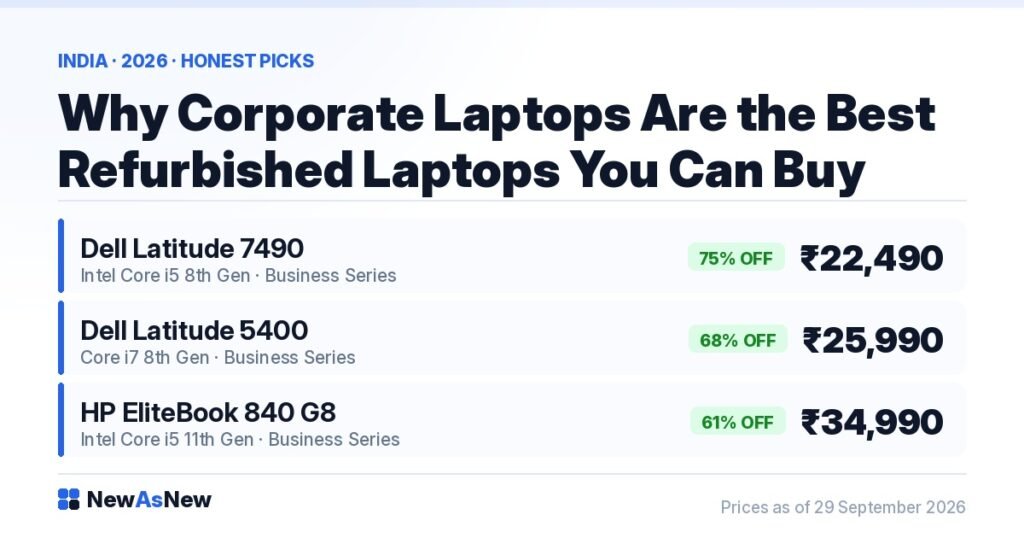
Short answer: Ex-corporate laptops are the best refurbished buy in India because companies replace them on a policy cycle, not because they broke. A Dell Latitude 7490 Core i5 at ₹22,490 is 75% off its ₹88,999 launch MRP — a business machine with a magnesium chassis, a published service manual and readily available spares. The trade-off is an older processor generation. Look for Dell Latitude, HP EliteBook or Lenovo ThinkPad, 8th Gen Intel or newer, and an SSD.
Prices are live as of 29 September 2026 and move with stock — check the linked product page for today’s exact price.
What is a corporate IT refresh, and why does it create bargains?
Large organisations — banks, consulting firms, IT services companies, multinationals with an India office — do not replace laptops when they fail. They replace them on a schedule, typically every three to four years, for reasons unrelated to the condition of the hardware:
- IT policy. A fixed refresh cycle is easier to budget, support and secure than a mixed-age fleet.
- Depreciation. The asset has been written down; replacing it is a planned line item, not an emergency.
- Standardisation. One model across the company simplifies imaging, spares and support.
- Lease expiry. Many large fleets are leased, and at end of term the machines go back regardless.
- OS support cycles. A platform deadline retires a working fleet on a date — Windows 10 support ending in October 2026 is exactly this force at work.
The result is thousands of three-to-four-year-old business laptops entering the secondary market at once, in working order, with no urgency behind the sale. That is a fundamentally different supply from a consumer selling a laptop because something went wrong. This refresh channel is where most of the good Grade A business stock in India comes from, ours included.
Why is a used corporate laptop better than a used consumer laptop?
Four reasons, in order of how much they matter.
The machine was specified to be repaired, not replaced. This is the biggest and least discussed. A buyer purchasing five thousand laptops demands that a technician can open the machine and swap a keyboard, battery, fan or SSD. So Dell, HP and Lenovo publish full service manuals for Latitude, EliteBook and ThinkPad, use standard screws instead of glue, and keep spares in the channel for years. A consumer laptop at the same original price is often glued shut with a soldered SSD. Years later, one is still economically repairable and the other is not.
The build spec was written against an eight-hour day. Magnesium alloy or reinforced composite chassis, hinges rated for years of daily opening, spill-channel keyboards, and in many cases manufacturer testing against the MIL-STD-810 environmental series — what that proves and does not prove is in why ex-corporate laptops are built better.
The use pattern was gentle and predictable. Office, email, a browser and video calls, at a desk, in an air-conditioned building. No gaming thermals, no dust, no charging off a car inverter. Compare a consumer laptop that spent four years on a bed with the vents blocked.
Somebody maintained it. Corporate machines live under managed IT: firmware updated, faults logged and fixed under contract, fans cleaned at service visits. A machine that developed a fault in year two very likely had it repaired in year two.
| Ex-corporate business laptop | Used consumer laptop | |
|---|---|---|
| Why it was sold | Policy refresh or lease expiry | Often because something went wrong |
| Original price class | ₹80,000 to ₹1,30,000 | ₹35,000 to ₹60,000 |
| Chassis | Magnesium alloy or reinforced composite | Plastic |
| Service manual published | Yes | Rarely |
| Spare parts availability | Good, years after launch | Poor once the model is retired |
| Maintenance history | Managed by an IT department | Unknown |
| Use environment | Office desk | Unknown |
| Bloatware | Gone after a clean OS install | Whatever the previous owner installed |
What is the catch?
Two real ones. Anyone who tells you there are none is selling, not advising.
The processor generation is behind. A machine leaving a corporate fleet in 2026 was bought around 2021 or 2022, and much of the Indian secondary market is older still — 8th and 10th Gen Intel are the volume tiers. For everyday work this matters less than the spec sheet suggests; we put numbers on it in 8th vs 10th vs 11th Gen Intel. But it is a genuine ceiling: these machines have integrated graphics, and no discount makes an integrated GPU suitable for work that needs a discrete one. See integrated vs dedicated graphics.
Bulk lots are inconsistent — our problem to solve, not yours. Corporate stock arrives in mixed lots: same model, varying RAM, storage and wear, plus occasional outliers genuinely abused by one employee. A “reputable corporate source” is not a guarantee about any individual unit, which is why we inspect every unit against the 50-point quality check rather than trusting the lot. Units that do not qualify are not listed — here is what happens to them.
One thing we will not do is publish an average battery cycle count across our stock. We have not measured it in a way that would make the number honest, and a made-up figure is exactly what this industry is full of. What we will do is tell you the condition of the specific unit you are looking at if you ask on WhatsApp.
What should you look for when buying one?
| What to check | What good looks like | Why |
|---|---|---|
| Product line | Dell Latitude, HP EliteBook, Lenovo ThinkPad | These are the serviceable corporate lines with published manuals |
| Processor generation | 8th Gen Intel minimum, 10th or 11th for comfort | Older than 8th Gen narrows your Windows 11 options |
| Storage | SSD, capacity stated on the listing | Storage type decides how fast the machine feels |
| RAM | 8GB workable, 16GB comfortable | 16GB is common in corporate stock and cheap to find |
| Battery health | Stated as a figure, not as “good” | The one component that ages on a calendar |
| Battery cycle count | Ask for the actual number on that unit | A specific number beats any seller’s average |
| Windows licence | Genuine and activated | Corporate volume keys do not transfer to you |
| Invoice | GST invoice in your or your company’s name | Legal proof of purchase and input credit |
| Warranty and returns | In writing, before you pay | “Contact us if there is an issue” is not a warranty |
On Windows you can read the battery report yourself in about a minute — the command is in how to check laptop battery health in 60 seconds. The licence question trips up buyers of ex-corporate stock specifically, because the machine may arrive carrying a company volume key that was never yours to use: do refurbished laptops come with a genuine Windows licence.
Which in-stock ex-corporate laptops are worth it today?
- Dell Latitude 7490, Core i5 8th Gen, Grade A Certified — ₹22,490 (MRP ₹88,999, 75% off). The thin-and-light corporate workhorse; the best entry point into this category.
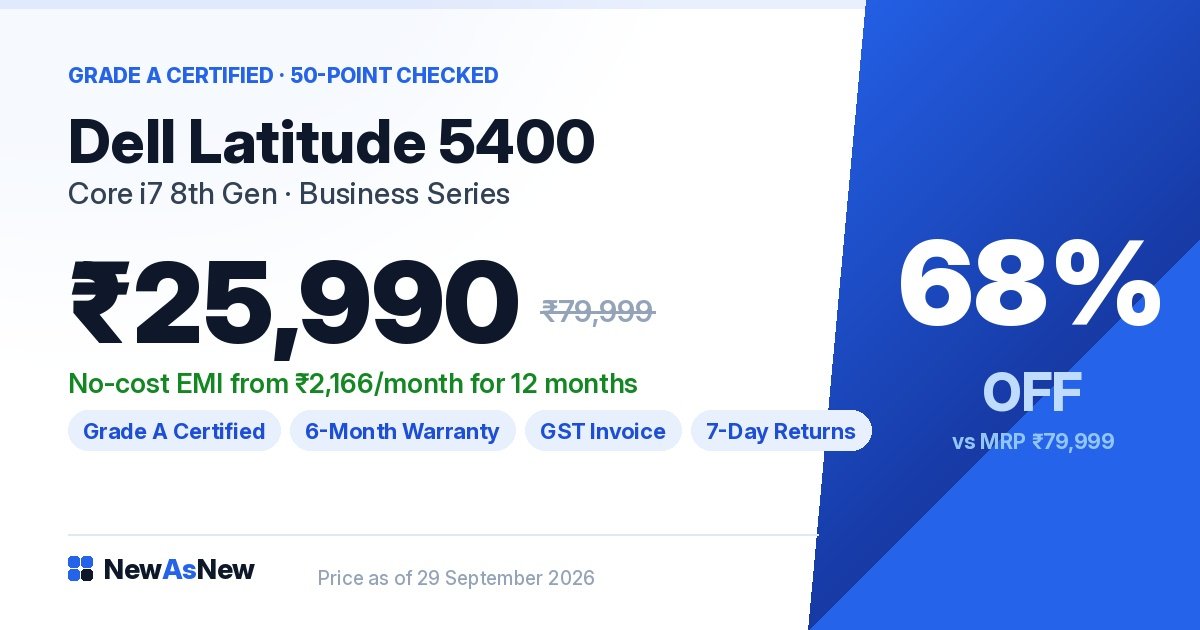
- Dell Latitude 5400, Core i7 8th Gen, Grade A Certified — ₹25,990 (MRP ₹79,999, 68% off). i7 and a chassis with room to upgrade RAM and storage later.
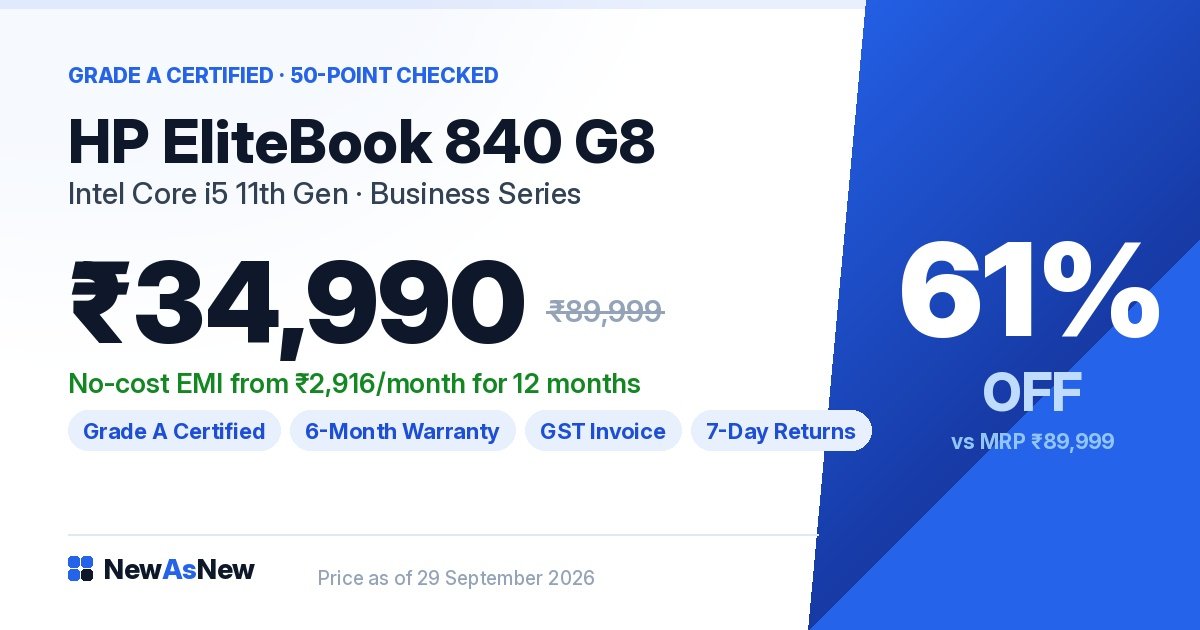
- HP EliteBook 840 G8, Core i5 11th Gen, Grade A Certified — ₹34,990 (MRP ₹89,999, 61% off). 11th Gen, so it stays useful for years longer.
- Dell Latitude 5421, Core i7 11th Gen H-series, Grade A Certified — ₹44,990 (MRP ₹89,999, 50% off). H-series silicon, for sustained heavy work.
Choosing between the three big corporate brands is its own decision, and we compared them directly in Dell Latitude vs HP EliteBook vs Lenovo ThinkPad. Buying several for a team? Start with refurbished laptops for startups and small offices.
Who should not buy an ex-corporate laptop?
Anyone who needs a discrete GPU. 4K video editors, 3D and CAD users, ML practitioners needing CUDA, and gamers. The mainstream Latitude and EliteBook lines have integrated graphics. If you need a GPU, either look at a mobile workstation — a Dell Precision 5550 with 4GB dedicated graphics is ₹53,990, 68% off its ₹1,69,999 MRP — or buy new. Do not buy a ₹22,490 i5 and hope.
Anyone who wants the thinnest, lightest, longest-battery machine available. A current MacBook Air or new premium ultrabook beats a 2018 business laptop on weight, silence and battery life. If those are what you value most, pay for them — an Unboxed MacBook Air 2024 M3 at ₹74,990 is the honest middle route.
Anyone who cannot tolerate cosmetic marks. These machines came out of offices. Grade A means restored and verified, not flawless; palm-rest shine and faint lid marks are normal and disclosed. If that will bother you daily, buy Unboxed — see the Unboxed vs Grade A framework.
Anyone buying from an unverified seller because it is ₹3,000 cheaper. This whole page depends on somebody inspecting the individual unit. A corporate-surplus laptop from a bulk lot with no QC, no warranty, no invoice and no returns is not the product described here — it is a lottery ticket that happens to be the same model. See the 7 mistakes guide.
What “Excellent” battery health means here: above 80% of original design capacity on a laptop, and above 85% on a smartphone. The thresholds differ because the two age differently — a laptop spends most of its life on mains power, a phone is cycled every day. Anything below that is not listed; there is no lower battery tier. The measured figure for your exact unit is printed on its product page.
Frequently asked questions
What is a corporate IT refresh laptop?
A laptop retired from a company fleet on a schedule rather than because it failed. Large organisations replace employee machines roughly every three to four years for IT policy, depreciation, standardisation, lease-expiry or operating-system support reasons. The hardware is still working, which is what makes this supply different from a consumer selling a laptop that developed a problem.
Why are corporate refurbished laptops better than consumer refurbished?
Mainly because they were specified to be repaired rather than replaced — Dell Latitude, HP EliteBook and Lenovo ThinkPad have published service manuals, standard screws instead of glue, and spares in the channel years after launch. They also have stronger chassis and keyboards built for an eight-hour day, a gentle office use pattern, and a maintenance history under managed IT.
Which corporate laptop brands should I look for?
Dell Latitude, HP EliteBook and Lenovo ThinkPad are the three corporate standards. For processors, 8th Gen Intel is a sensible floor and 10th or 11th Gen more comfortable if the budget reaches. Anything older than 8th Gen narrows your Windows 11 options.
What battery cycle count should I expect on a corporate laptop?
We will not quote an average, because we have not measured one across our stock in a way that would make the number honest, and this industry is already full of invented figures. Ask us for the actual reading on the specific unit you are considering. On Windows you can also generate the battery report yourself in about a minute after delivery.
Do ex-corporate laptops come with a genuine Windows licence?
They should, and it is worth checking specifically with this category, because the machine may have run on a company volume licence that does not transfer to you. Ask the seller to confirm the licence is genuine and activated for you, and get it in writing.
Can I upgrade the RAM and SSD on an ex-corporate laptop?
Usually yes, and far more easily than on a consumer machine of the same era — that serviceability is the point of these lines. Whether it is worth doing versus simply buying a higher-spec unit is worked through in upgrade RAM and SSD yourself, or buy a higher-spec refurbished laptop. Note that opening the device yourself affects your warranty, so talk to us first.
Where to go next
Browse all certified refurbished and unboxed laptops, or jump to a budget: under ₹25,000, under ₹35,000 or under ₹50,000.
Want to know the exact condition of a specific unit before you pay? WhatsApp +91 79822 35917 with the product link. We will send real photographs of that unit and its battery reading.
Written by the NewAsNew team in New Delhi. We buy from the corporate refresh channel, and we inspect every single unit from every lot rather than trusting the lot — because a good source is not a guarantee about your machine. Read our story.