Airpods & Earbuds (Unboxed)
  Camera & Lenses (Unboxed)
  Headphones (Unboxed)
  Laptops (Unboxed)
  MacBooks (Unboxed)
  Mobile Accessories (Unboxed)
  Monitors (Unboxed)
  Wearables (Unboxed)
  Laptops (Grade A)
  Monitors (Grade A)
  Smartphone (Grade A)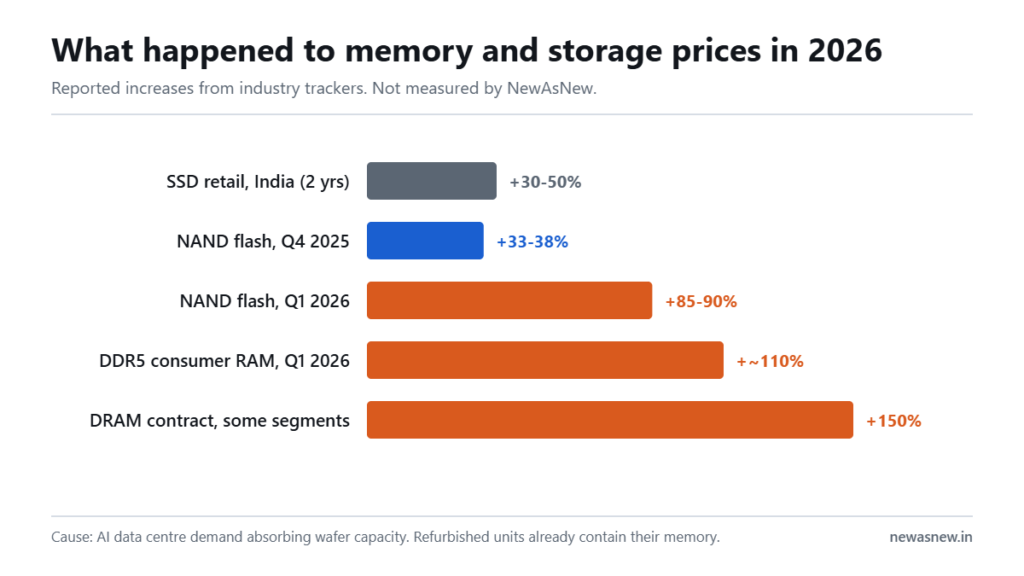
Short answer: Laptop prices in India are climbing in 2026 because RAM and SSD chips have become dramatically more expensive. Industry trackers report DDR5 contract prices up roughly 110% and NAND flash up 85-90% in the first quarter of 2026, as AI data centres absorb the world memory supply. New laptops are absorbing that cost. A refurbished Dell Latitude 5400 Core i7 at Rs 22,490 was built and its memory bought before the spike, which is why the gap has widened this year rather than narrowed.
Prices are live as of 6 September 2026 and move with stock — check the linked product page for the current figure before you decide.
What actually happened to memory prices in 2026?
Two separate chips got expensive at the same time, for the same underlying reason.
DRAM is your RAM — the working memory a laptop uses while you have twenty Chrome tabs and an Excel file open. NAND flash is what an SSD is made of. Both are made on the same kind of wafer capacity that AI accelerators need for high-bandwidth memory (HBM). When the world decided to build AI data centres, memory makers moved capacity to the customer paying the most. Consumer RAM and consumer SSDs were not that customer.
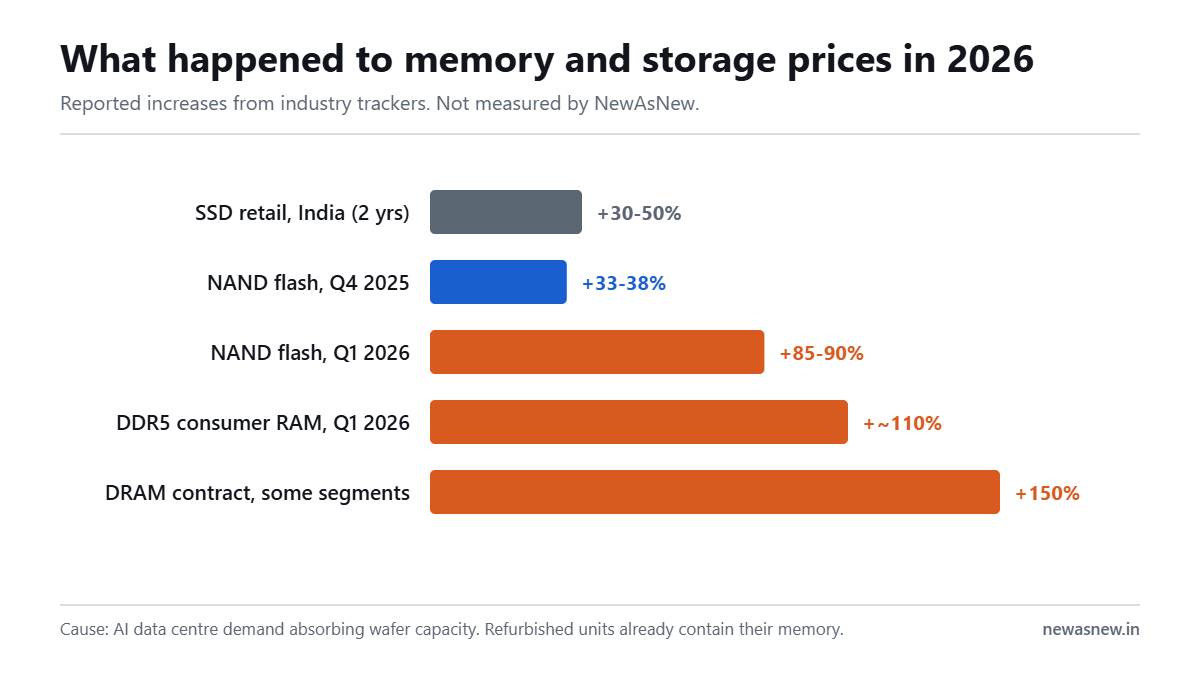
The numbers reported by industry trackers through 2026:
| Component | Reported move | Period |
|---|---|---|
| DDR5 consumer RAM | up roughly 110% | Q1 2026 |
| DDR5 per-GB spot pricing | about $6.84/GB to about $27.20/GB | Sep 2025 to Dec 2025 |
| NAND flash (SSD raw cost) | up 33-38%, then a further 85-90% | Q4 2025, then Q1 2026 |
| DRAM contract prices overall | up more than 100%, some segments more than 150% | year to Q1 2026 |
| SSD retail prices in India | up roughly 30-50% | mid-2024 to mid-2026 |
A note on where these come from, because it matters. We did not measure any of this. These are figures published by memory-market trackers and technology press through 2026, and different trackers report slightly different numbers because they measure contract prices, spot prices and retail prices, which are three different things. We publish the ranges we found rather than picking the most dramatic one. What we can speak to first-hand is the second half of this article — what it does to what we can buy and what we can sell.
Why does that make a laptop in a Delhi shop more expensive?
Memory is not a small line item. On a typical Rs 55,000 new consumer laptop, the 16GB of RAM and the 512GB SSD together are a meaningful share of the bill of materials. When that share doubles, the manufacturer has three options: raise the price, cut the specification, or absorb the cost. Through 2026 the industry has mostly done the first two. Reports through the year had major PC makers including ASUS and Acer raising consumer pricing to cope with memory costs.
The second option is the one Indian buyers should watch for, because it is quieter. A laptop that held its price tag but quietly moved from 16GB to 8GB, or from a 512GB SSD to 256GB, has gone up in price — you are simply paying the same money for less machine. If you are comparing a 2026 model against its 2024 equivalent, compare the specification line by line, not the price tag.
India adds two more multipliers on top of the global ones. Storage and memory are imported and paid for in dollars, so rupee movement flows straight through, and component tariffs in the wider electronics supply chain add their own layer. This is why the reported Indian retail rise in SSDs — roughly 30-50% over two years — does not exactly track the global chip figures.
Does this affect refurbished laptops the same way?
Not in the same way, and this is the honest core of the article.
A refurbished Dell Latitude or HP EliteBook already contains its RAM and its SSD. That memory was manufactured and paid for years ago, at pre-shortage prices. The device exists. Nobody has to buy a DDR5 module at 2026 prices to bring it to market. That is a real structural advantage and it is why the value gap widened in 2026 rather than closing.
Where the shortage does reach us: upgrades. If a unit comes to our bench with 8GB and we want to ship it at 16GB, we buy that extra module at 2026 prices like everyone else. That is a genuine cost and we would rather say so than pretend the shortage stops at our door. In practice it means we increasingly prefer to source units that already carry the memory they need, rather than upgrade them after the fact.
What is actually in stock right now, and at what price?
Live in-stock Grade A Certified laptops as of 6 September 2026:
| Model | Price | Best for |
|---|---|---|
| Dell Latitude 7490 Core i5 8th Gen | Rs 22,490 | Students, documents, classes, light multitasking |
| Dell Latitude 5400 Core i7 8th Gen | Rs 22,490 | The value pick — i7 at the i5 price |
| Dell Latitude 5490 Core i5 8th Gen | Rs 23,490 | Everyday work-from-home |
| Dell Latitude 7400 Core i7 8th Gen | Rs 24,490 | Thin, light, all-day carry |
| HP EliteBook 830 G8 Core i5 10th Gen | Rs 32,990 | Compact 13-inch business machine |
| HP EliteBook 840 G8 Core i5 11th Gen | Rs 32,990 | Newer generation, 14-inch, Iris Xe graphics |
| Dell Latitude 5320 2-in-1 Touch i5 11th Gen | Rs 38,990 | Touch and pen work, 360-degree hinge |
| HP EliteBook 840 G8 Core i7 11th Gen | Rs 39,990 | Heavier multitasking |
| Dell Latitude 5421 Core i7 11th Gen H-Series | Rs 39,990 | 45W H-series chip, sustained load |
| Dell Precision 5550 Core i7 10th Gen | Rs 48,490 | Workstation, editing, CAD |
| Dell Precision 3551 Core i7 10th Gen | Rs 48,990 | Workstation with dedicated graphics |
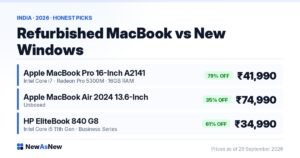
Note the first two rows. The Latitude 5400 with a Core i7 is Rs 22,490 while the same chassis with a Core i5 is Rs 22,990. The i7 is Rs 500 cheaper. That is not a typo and it is not a promotion — refurbished pricing is set by what a unit costs us and what condition it arrives in, not by the badge on the sticker. It is one of the clearest illustrations of how differently this market prices things.
Should you wait for RAM prices to come down?
If you need a laptop for work or study in the next few months, no. Supply analysts through 2026 have pointed to tight NAND and DRAM availability lasting at least to the end of the year, and the fundamental driver — AI infrastructure demand — is not a seasonal blip. Waiting six months to save an amount that may not materialise, while working on a machine that is slowing you down, is a bad trade.
If you are building a desktop and the only missing part is RAM, that is a different question and waiting may genuinely pay. But that is not what most people reading this are doing.
Who should NOT buy refurbished right now — and spend more instead
We would rather lose the sale than have you unhappy in three months. Buy new, not refurbished, if:
- You need the latest thin-and-light with 20-hour battery life. A 2018-2021 business laptop with a healthy battery gives you real hours, not marketing hours. If all-day-unplugged is non-negotiable, buy new.
- You need a warranty longer than a year. Our Assured Warranty is 6 months, plus any remaining brand warranty on Unboxed units up to 12 months. If your workplace requires three years of on-site support, buy new with that contract.
- You do serious 3D, AI training or heavy video work. A Precision 3551 will handle a lot, but if you need a current RTX-class GPU, no refurbished business laptop at these prices replaces it.
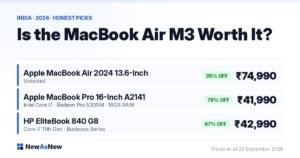
- You want the newest Apple silicon. Our MacBook Air M3 at Rs 74,990 is Unboxed and genuinely good value, but if you specifically want the newest M-series chip, buy it new.
- You cannot tolerate cosmetic marks. Grade A Certified means restored and fully functional, not factory-perfect. If a faint mark on a lid will bother you daily, pay for new.
What to check before you buy any laptop in 2026
- RAM amount and whether it is upgradeable. Many modern thin laptops solder the RAM. With memory this expensive, a soldered 8GB machine is a machine you cannot rescue later. Business-series laptops usually have SODIMM slots.
- SSD size and type. 256GB is tight in 2026. Check whether it is NVMe or SATA, and whether there is a spare M.2 slot.
- Battery health percentage, stated as a number, not as an adjective. Ask for it.
- A GST invoice. If a seller cannot issue one, walk away — it is the paperwork that makes a warranty claim and a return possible.
- What the warranty actually covers, in writing, before payment.
What we can ship today
Every unit below is in stock as this page was last checked, with a 6-month NewAsNew Assured Warranty, GST invoice, 7-day returns and no-cost EMI. If it is listed here, we can dispatch it.
| Model | Price | MRP | You save |
|---|---|---|---|
| Dell Latitude 7490 Intel Core i5 8th Gen Laptop · Business Series |
₹22,490 | ₹88,999 | 75% |
| Dell Latitude 5400 Core i7 8th Gen Laptop · Business Series |
₹25,990 | ₹79,999 | 68% |
| Dell Latitude 5310 2-in-1 Core i5 10th Gen Laptop · 360° Convertible · Business Series |
₹39,990 | ₹89,000 | 55% |
| Dell Precision 3551 Core i7 10th Gen Laptop · 4GB Graphics · Mobile Workstation |
₹54,990 | ₹149,999 | 63% |
Prices checked on 29 September 2026 — stock and prices move, so the linked product page is always the truth.
Browse all laptops in stock · Ask us on WhatsApp which one fits you
Frequently asked questions
Why are RAM prices so high in 2026?
Because AI data centres are buying the wafer capacity that used to make consumer memory. High-bandwidth memory for AI accelerators is far more profitable per wafer than DDR5 sticks, so manufacturers shifted production. Industry trackers reported DDR5 consumer prices rising roughly 110% in the first quarter of 2026 as a result.
Will laptop prices in India come down in 2026?
Analysts through 2026 have pointed to tight memory and NAND supply persisting at least to the end of the year. Nobody credible is forecasting a sharp fall in the next few months. Treat any specific prediction, including this one, with caution — this is a market that surprised everyone once already.
Are refurbished laptop prices also rising?
Less, and for a different reason. A refurbished unit already contains its RAM and SSD, bought years ago. Our sourcing costs move with supply and demand for used business hardware, not with the DDR5 spot market. Where the shortage does hit us is when we upgrade a unit memory before shipping it.
Should I buy 8GB now and upgrade RAM later?
In 2026, usually not. The upgrade module is precisely the thing that has doubled in price. If your budget stretches to a 16GB machine today, take it. If it does not, buy an 8GB laptop that has a free SODIMM slot so the option stays open, and avoid soldered-RAM models.
Is a refurbished laptop with an older Intel chip still worth it in 2026?
For documents, browsing, classes, accounting software and video calls, an 8th Gen Core i5 or i7 is still comfortably enough, and 8th Gen is the oldest generation Windows 11 officially supports. For heavy code compilation, large datasets or video editing, move up to 10th or 11th Gen.
Does the memory shortage affect phones and headphones too?
Phones yes — they use the same NAND and mobile DRAM. Headphones and earbuds barely, because they use tiny amounts of memory. That is part of why audio pricing has been much more stable than laptop and phone pricing this year.
What is the cheapest laptop NewAsNew has in stock right now?
Rs 22,490, for either the Dell Latitude 7490 Core i5 8th Gen or the Dell Latitude 5400 Core i7 8th Gen, both Grade A Certified with a 6-month NewAsNew Assured Warranty, 7-day returns and a GST invoice. Stock moves, so check the live page.
Related guides
- Best refurbished laptops in India 2026, by budget
- Intel Core i5 vs i7 in refurbished laptops
- 8th vs 10th vs 11th Gen: the real-world difference
- Laptop battery health percentage, explained
Still deciding? Talk to a human
Send us the work you do and your budget on WhatsApp and we will tell you honestly whether we have something for you — or whether you should wait. Chat with NewAsNew on WhatsApp (+91 79822 35917).
Browse live stock: Grade A Certified laptops · Refurbished iPhones · Unboxed headphones · Unboxed earbuds.
Written by Atul Pandey, co-founder of NewAsNew (NextG Serve Private Limited, New Delhi). We came from four years of offline electronics retail in Prayagraj before building NewAsNew. Only 2 to 3 out of every 10 devices that reach our QC bench pass; the other 7 to 8 go back to the supplier. The exact figure moves month to month with the stock we are offered, so we publish the range rather than one flattering number. Read our story.