Airpods & Earbuds (Unboxed)
  Camera & Lenses (Unboxed)
  Headphones (Unboxed)
  Laptops (Unboxed)
  MacBooks (Unboxed)
  Mobile Accessories (Unboxed)
  Monitors (Unboxed)
  Wearables (Unboxed)
  Laptops (Grade A)
  Monitors (Grade A)
  Smartphone (Grade A)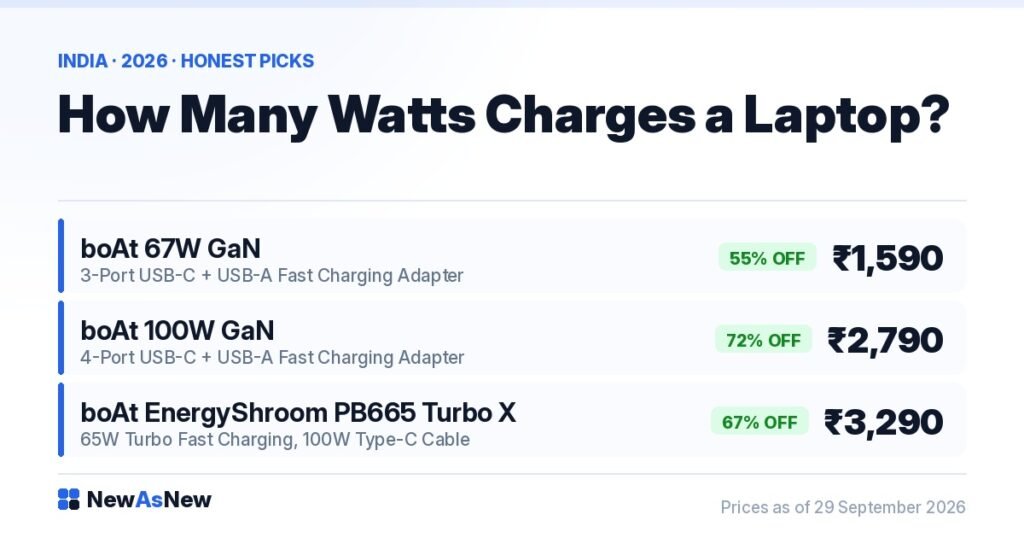
Short answer: Most laptops need 45W to 100W over USB-C Power Delivery. A 65W-class charger — such as the boAt 67W GaN 3-port at ₹1,590 (55% off MRP ₹3,499) — charges almost every 14-inch business laptop at full speed, and only slows when the CPU is under heavy load. Go to the boAt 100W GaN at ₹2,790 for a 16-inch MacBook Pro, a mobile workstation, or charging several devices at once.
Prices are live as of 29 September 2026 and move with stock — check the linked product page for today’s exact price.
Where do I find the number my laptop actually needs?
On the adapter it came with. Turn your existing brick over and read the output line. It will say something like 20V — 3.25A. Multiply the two and you get watts: 20 × 3.25 = 65W. That is your laptop’s design figure.
If the label shows several output pairs, the highest product is the one that matters. If the laptop uses a round barrel plug and no USB-C port, it cannot charge over USB-C at all, whatever the wattage.
Almost every business laptop from roughly 2018 onward supports USB-C charging. Dell Latitude 5000 and 7000 series, HP EliteBook 800 series, and all Apple laptops from 2016 onward charge over USB-C. Older machines are often barrel-only. Our laptop ports guide explains why two identical-looking USB-C ports can behave completely differently.
How does USB-C Power Delivery decide what to send?
It is a negotiation, not a push. The laptop tells the charger which voltage and current pairs it can accept. The charger replies with what it can offer. They agree on the highest profile both support, and only then does power flow.
This is why you cannot damage a laptop with an over-specified charger. A 100W brick does not force 100W into a MacBook Air; the Air asks for about 30W and gets 30W.
| PD voltage | At 3A | At 5A (needs e-marked cable) | Typically used for |
|---|---|---|---|
| 5V | 15W | 25W | Earbuds, accessories, trickle charge |
| 9V | 27W | 45W | Phones, tablets |
| 15V | 45W | 75W | Ultrabooks, small laptops |
| 20V | 60W | 100W | Business laptops, MacBook Pro |
Two things follow from that right-hand column. First, 100W over standard USB-C PD requires 20V at 5A, and 5A is only legal on a cable that carries an electronic marker chip. Second, the newer Extended Power Range part of the standard goes above 100W using 28V, 36V and 48V, up to 240W — but that needs both an EPR charger and an EPR cable, and very few Indian laptops ask for it.
What does each laptop class really need?
| Laptop | Stock adapter | Charges fine on 67W? | Worth 100W? |
|---|---|---|---|
| Dell Latitude 7490 / 5490 (8th Gen, 14-inch) | 65W | Yes, full speed | No |
| HP EliteBook 840 G8 / 830 G8 (11th Gen) | 65W | Yes, full speed | No |
| MacBook Air 13.6-inch M3 | 30–35W | Yes, with room spare | No |
| Dell Latitude 5421 (11th Gen H-series) | 90W class | Yes, slower under load | Yes |
| Dell Precision 3551 / 5550 (dedicated GPU) | 130W class | Charges, not for heavy work | Yes, still below stock |
| MacBook Pro 16-inch A2141 (Intel) | 96W | Charges, slower under load | Yes, matches stock |
The honest summary: for the laptops most Indians are actually buying — 14-inch business machines in the ₹22,000 to ₹45,000 band — 65W is the right answer and 100W is an upgrade you will never feel. Look at our under ₹35,000 picks and you will see 65W adapters across almost the entire list.
What happens if the charger is underpowered?
Nothing dramatic. Three things happen, in this order.
It charges more slowly. A 45W charger on a 65W laptop still fills the battery; it just takes longer.
Under load, charging stalls. The CPU takes what it needs first. If you are exporting video on a 65W laptop with a 45W charger, the system may hold the battery level steady or drain it slowly while plugged in. This is not damage — it is arithmetic.
You may see a warning. Dell and HP firmware often display a “slow charger detected” or “AC adapter type cannot be determined” message, and some machines deliberately reduce CPU boost while on an underpowered adapter. Annoying, harmless, reversible.
What does not happen is battery damage. If your battery already drains fast, the charger is not the cause — check the cell with our 60-second battery health test.
Which charger should you buy?
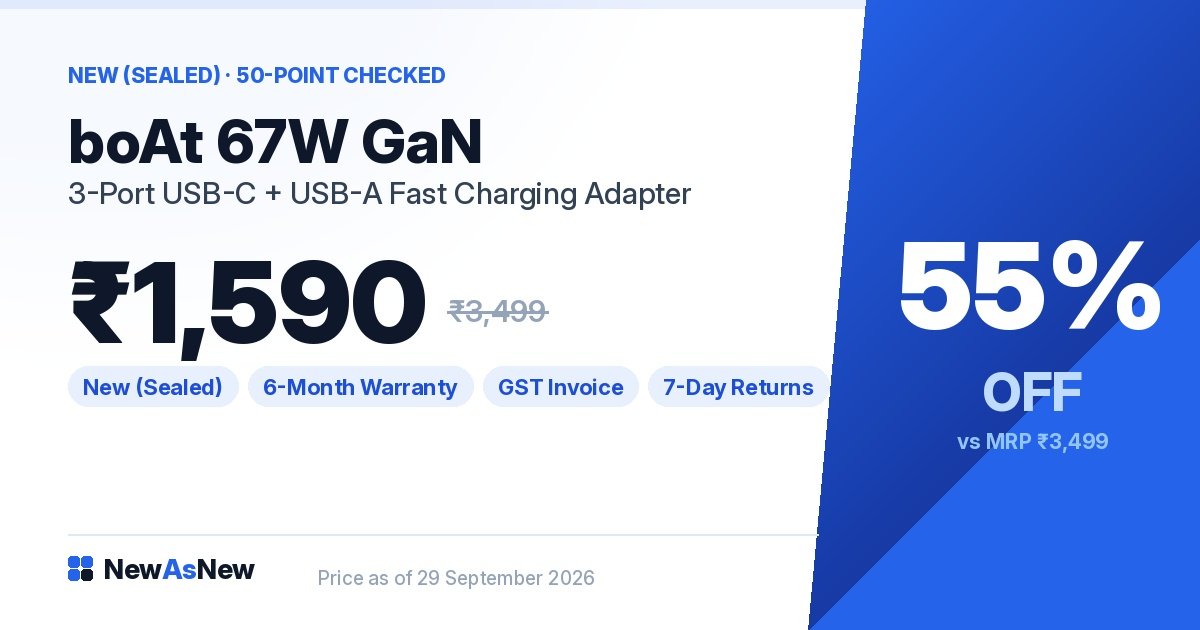
For nearly every reader: boAt 67W GaN Laptop Charger, 3-port USB-C + USB-A — ₹1,590 (MRP ₹3,499, 55% off). Enough for a Dell Latitude 5490 (₹23,490) at full speed, with two ports left for a phone and earbuds.
For big machines or busy desks: boAt 100W GaN Laptop Charger, 4-port USB-C + USB-A — ₹2,790 (MRP ₹9,999, 72% off). Remember that the 100W is a shared budget across four ports, not 100W each. Plug in a laptop and two phones and the controller divides it.

If there is no socket at all: boAt EnergyShroom PB665 Turbo X 30000mAh, 65W turbo with 100W cable — ₹3,290 (Unboxed, MRP ₹9,999, 67% off). About 111Wh stored, 67–78Wh delivered, which is roughly one full charge of a 14-inch laptop plus a phone. It is above the 100Wh airline threshold, so it needs airline approval — buy it for trains and field work, not flights.
Who should NOT buy a new laptop charger
If your original adapter works, keep it. A second charger is a convenience purchase. If you work at one desk, that convenience is worth nothing.
If your laptop is barrel-only, a USB-C charger will not work. No wattage fixes a missing feature. Check the port before buying.
If you own a gaming laptop needing 180W or more, do not buy 100W expecting it to cope. It will hold the machine at idle and charge it slowly when off. It will not sustain a gaming or rendering load. Use the manufacturer’s brick.
If your real complaint is a battery that lasts an hour, a charger is the wrong purchase. Replace the battery or read how to extend a laptop’s life by three years.
If you bought a 60W cable, do not buy a 100W charger yet. Buy the 5A e-marked cable first — that may be your entire bottleneck, at a fraction of the cost.
Frequently asked questions
Can I charge a 90W laptop with a 65W charger?
Yes. It charges more slowly and may pause charging under heavy CPU load, but nothing is damaged. Many people run this way daily with no issue.
Is a higher-wattage charger bad for my laptop battery?
No. USB-C PD is a negotiated standard — the laptop requests what it can handle and the charger supplies exactly that. Over-specifying is safe.
Why is my laptop charging slowly on a 100W charger?
Usually the cable. 100W needs 20V at 5A, which requires an e-marked cable; a standard 60W cable caps you at 60W. Otherwise, check whether other devices are sharing the charger’s total budget.
Do all USB-C ports on a laptop support charging?
No. Some laptops accept charging on only one specific USB-C port, and that port is often marked with a small battery or lightning icon. Check your manual.
Can a power bank charge a laptop?
Yes, if it supports USB-C PD at 45W or more. The 30,000mAh PB665 at ₹3,290 delivers 65W, enough for a 14-inch business laptop. A 22.5W phone bank will not do it properly.
How long does 65W take to charge a laptop?
A typical 14-inch business laptop with a 50–60Wh battery reaches full in roughly two hours from near-empty, faster to 80% and slower for the final stretch as the charge rate tapers.
Is 45W enough for a MacBook Air M3?
Yes, comfortably. The M3 Air charges at around 30–35W, so 45W leaves headroom. Only the fast-charge feature on larger MacBooks needs more.
Do refurbished laptops from NewAsNew include a charger?
Yes, every laptop ships with a compatible adapter, along with warranty, a GST invoice and 7-day returns. Details in our refurbished laptop warranty guide.
Read next: Laptop Ports Explained: Thunderbolt vs USB-C vs USB 3.2, Unboxed Mobile Accessories in India, and Best Refurbished Laptops for Work From Home in India.
Send us a photo of your existing adapter label on WhatsApp at wa.me/917982235917 and we will read the wattage for you and say plainly whether 67W is enough — or whether you do not need a new charger at all.
Written by the NewAsNew team, NextG Serve Pvt. Ltd., New Delhi. We test every charger against the laptops we actually stock, from 8th Gen Latitudes to Precision workstations, before we recommend a wattage. Read our story.