Airpods & Earbuds (Unboxed)
  Camera & Lenses (Unboxed)
  Headphones (Unboxed)
  Laptops (Unboxed)
  MacBooks (Unboxed)
  Mobile Accessories (Unboxed)
  Monitors (Unboxed)
  Wearables (Unboxed)
  Laptops (Grade A)
  Monitors (Grade A)
  Smartphone (Grade A)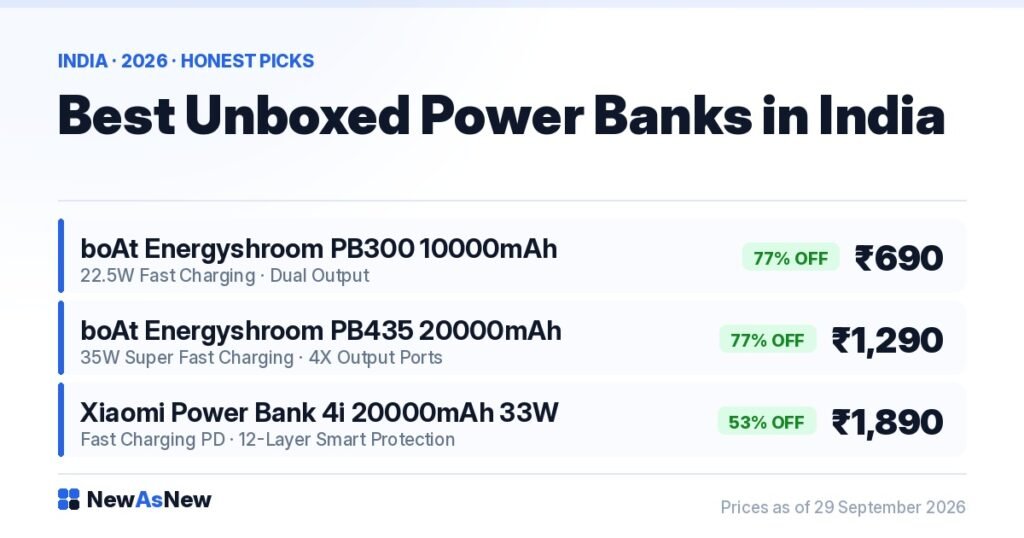
Short answer: For most people in India, a 20,000mAh bank with 30W or more output is the right buy. The boAt Energyshroom PB435 20000mAh at ₹1,290 (77% off MRP ₹5,499) gives roughly two and a half phone charges and four output ports. If you only carry a phone, the 10,000mAh boAt PB300 at ₹690 is honestly enough. Buy a 27,000mAh or 30,000mAh laptop bank only if you genuinely charge a laptop away from a socket.
Prices are live as of 29 September 2026 and move with stock — check the linked product page for today’s exact price.
How much capacity do you actually need?
Almost every power bank mistake in India is a capacity mistake. People buy 20,000mAh because it sounds safer, then carry 400 grams of dead weight in a laptop bag every day for a top-up they take twice a month.
Start from the number that matters: watt-hours, not mAh. A power bank’s cells sit at a nominal 3.7V, so watt-hours are (mAh ÷ 1000) × 3.7. A 10,000mAh bank is about 37Wh. A 20,000mAh bank is about 74Wh. A 30,000mAh bank is about 111Wh.
Then subtract the losses. Your bank stores energy at 3.7V and has to push it out at 5V, 9V or 20V. That conversion is not free, and neither is the heat. In real use you get about 60–70% of the rated figure out of the port. This is physics, not a defect, and any brand claiming otherwise is marketing at you.
| Rated capacity | Watt-hours (at 3.7V) | Realistic usable output | Full phone charges | Who it is for |
|---|---|---|---|---|
| 10,000mAh | about 37Wh | 22–26Wh | 1 to 1.5 | One phone, daily commute, college |
| 20,000mAh | about 74Wh | 44–52Wh | 2.5 to 3 | Phone plus earbuds, travel, family sharing |
| 27,000mAh | about 100Wh | 60–70Wh | 4, or roughly 1 laptop charge | Field work, long train journeys |
| 30,000mAh | about 111Wh | 67–78Wh | 4 to 5, or 1 laptop charge plus a phone | Shoots, site work, power-cut regions |
A modern phone battery holds roughly 15–20Wh. Divide the usable column by that and you get the honest charge count, which is always lower than the number printed on the box.
Which unboxed power bank should most Indian buyers pick?
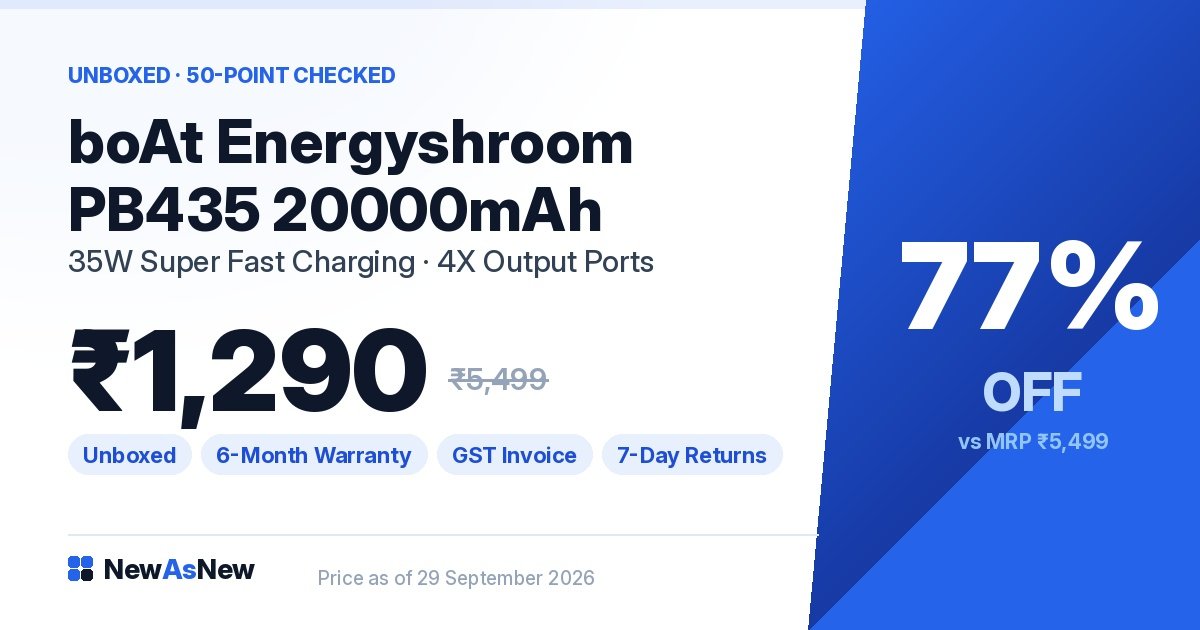
The default pick: boAt Energyshroom PB435 20000mAh, 35W, four output ports — ₹1,290 (Unboxed, MRP ₹5,499, 77% off). About 74Wh rated, so roughly 44–52Wh delivered. The four ports are the real reason to pick it: one phone, one pair of earbuds and a friend’s phone at the same time, on a Delhi-to-Lucknow train, without anybody waiting.
The cheapest sensible pick: boAt Energyshroom PB300 10000mAh, 22.5W, dual output — ₹690 (Unboxed, MRP ₹2,999, 77% off). Around 37Wh, so 22–26Wh usable — one full phone charge and a bit more. It is light enough that you will actually carry it, which is the only spec that matters if the alternative is leaving the big one at home.
If you want the safest-feeling build: Xiaomi Power Bank 4i 20000mAh, 33W PD, 12-layer protection — ₹1,890 (Unboxed, MRP ₹3,999, 53% off). Same 74Wh class as the PB435 and ₹600 dearer, so buy it for the protection circuitry and Xiaomi’s service reach, not for more power. If those do not matter to you, the PB435 is better value.
When does a laptop power bank make sense?
Only when you charge a laptop with no socket in sight. That is a short list: outdoor shoots, field surveys, long-distance trains, and offices in areas with unreliable supply.
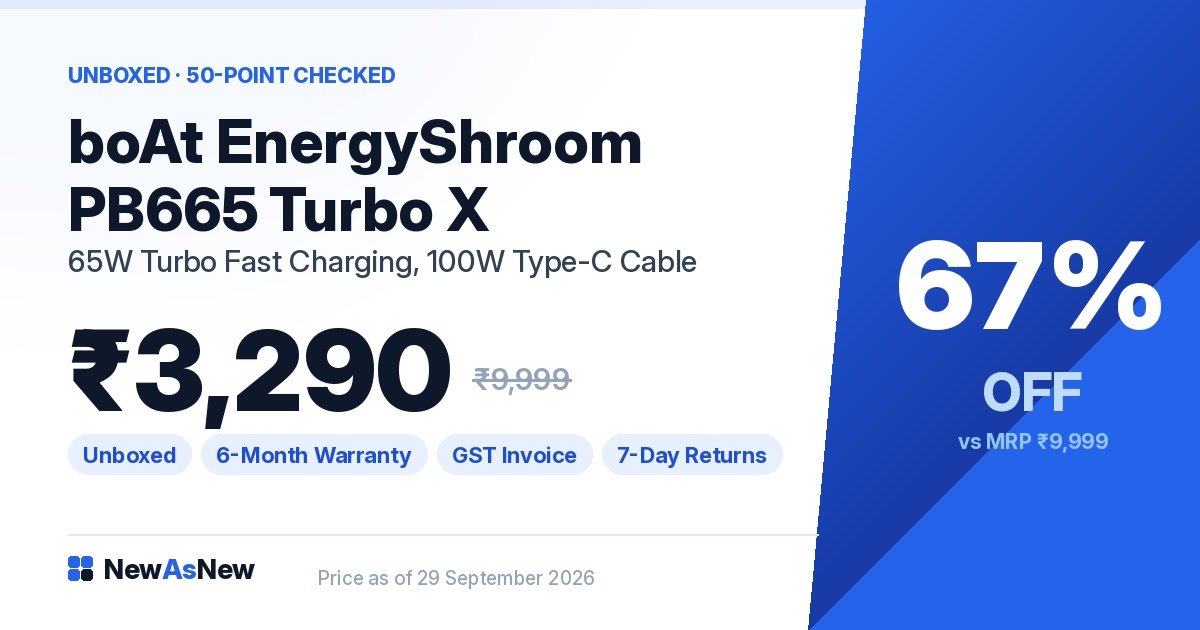
For that job the boAt EnergyShroom PB665 Turbo X 30000mAh, 65W turbo with 100W cable — ₹3,290 (Unboxed, MRP ₹9,999, 67% off) is the strongest value we stock. About 111Wh rated, 67–78Wh usable, and 65W is enough to charge a 14-inch business laptop — a Dell Latitude 7490 or an HP EliteBook 840 G8, the sort of machine in our under ₹25,000 picks — from near-empty in about two hours.
One important honesty point: at 111Wh the PB665 sits above the 100Wh airline threshold, so it is not the one to buy for flying. We cover exactly why in our guide to unboxed mobile accessories in India, and in detail in the mAh-versus-Wh explainer linked below.
Does Unboxed mean a used power bank?
No. Unboxed means the retail box was opened — a customer return, a display unit, a cancelled order — and the product itself is like-new. On power banks we specifically test that the cells hold charge, that every port negotiates its rated wattage, and that the unit does not run hot under load. Anything that fails goes back; we wrote about the 7 or 8 devices in 10 that we reject because that rejection rate is the actual product here.
Every unit ships with warranty, a GST invoice and 7-day returns. If the distinction between grades still feels fuzzy, read Unboxed vs Refurbished vs New: the honest difference before you buy anything from anyone.
Who should NOT buy a power bank from this list
If you are near a socket all day, skip it entirely. A desk worker who charges overnight at home and has a cable at the office does not need a power bank. Buy a second wall charger instead — it is cheaper, lighter and faster.
If you only ever need 20 minutes of emergency battery, do not buy 20,000mAh. The ₹690 PB300 is the correct answer and the ₹600 you save buys a decent cable, which is the part that usually fails first.
If you fly frequently, do not buy the 30,000mAh unit. At about 111Wh it needs airline approval in India and may be refused at the gate. A 20,000mAh unit at about 74Wh is comfortably under the 100Wh line.
If you want a power bank to fix a laptop that dies in 90 minutes, fix the laptop. A worn battery is a battery problem. Check it first with our 60-second battery health check.
If you need wireless magnetic charging for an iPhone, a plain wired bank will annoy you. Buy a MagSafe-compatible magnetic bank instead — we compare those separately.
Frequently asked questions
Is a 20,000mAh power bank allowed on Indian flights?
Yes, in cabin baggage only. At a nominal 3.7V a 20,000mAh bank is about 74Wh, well under the 100Wh limit that airlines allow without special permission. Never put a power bank in checked baggage.
Why does my 20,000mAh bank not charge my phone six times?
Because the rated capacity is measured at the 3.7V cell level, and output happens at 5V or higher. Voltage conversion and heat cost you roughly 30–40%. A 20,000mAh bank realistically delivers 44–52Wh, which is two and a half to three phone charges.
Is 22.5W fast enough, or do I need 35W?
22.5W fully charges most Android phones in about 80–90 minutes and is fine for daily use. 35W matters when you are charging two devices at once or want a 50% top-up in 25 minutes before leaving the house.
Can these power banks charge a laptop?
Only the higher-wattage ones. You need USB-C Power Delivery at 45W or more, which means the 30,000mAh PB665 at ₹3,290 in this list. A 22.5W bank will trickle-charge some ultrabooks at best, and many will refuse it outright.
Do unboxed power banks come with warranty in India?
Yes. Every unboxed power bank we sell carries warranty, a GST invoice and a 7-day return window. The terms are set out in our NewAsNew Assured warranty guide.
How long do power bank cells last?
Expect 300–500 full cycles before noticeable capacity loss, which for most users is two to three years. Heat is the enemy: leaving one on a car dashboard in an Indian summer ages it faster than the cycle count ever will.
Should I wait for the festive sale to buy?
On accessories, usually not. Unboxed pricing already sits 50–77% below MRP, which is deeper than most festive discounts on sealed stock. We explain the maths in Festive Season 2026: buy unboxed now or wait?
Is it safe to leave a power bank charging overnight?
On a unit with proper protection circuitry, yes — it stops drawing current when full. Do not do it on unbranded banks with no certification, and never charge one under a pillow or on a bed.
Next, read Unboxed Mobile Accessories in India: what to buy and what to avoid, Laptop Ports Explained: Thunderbolt vs USB-C vs USB 3.2, and 7 Mistakes People Make When Buying Refurbished Gadgets.
Not sure which capacity fits how you actually travel? Send us a message on WhatsApp at wa.me/917982235917 — tell us your phone model and your longest day away from a socket, and we will tell you the smallest bank that covers it, even if that is the ₹690 one.
Written by the NewAsNew team, NextG Serve Pvt. Ltd., New Delhi. We test every power bank’s ports and cell retention ourselves before it is listed, and we reject the ones that fail. Read our story.