Airpods & Earbuds (Unboxed)
  Camera & Lenses (Unboxed)
  Headphones (Unboxed)
  Laptops (Unboxed)
  MacBooks (Unboxed)
  Mobile Accessories (Unboxed)
  Monitors (Unboxed)
  Wearables (Unboxed)
  Laptops (Grade A)
  Monitors (Grade A)
  Smartphone (Grade A)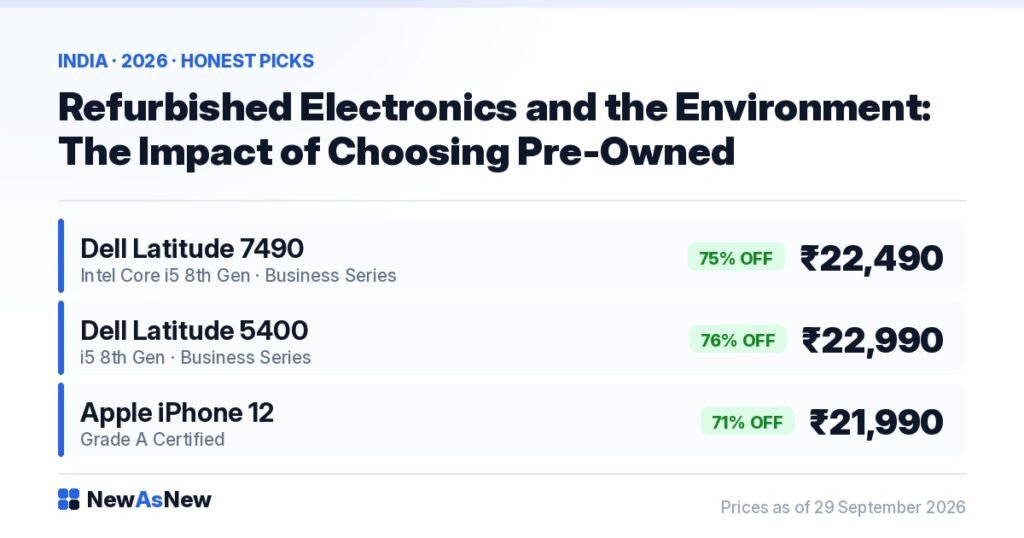
Short answer: Most of a laptop’s lifetime environmental impact happens before it is ever switched on, during manufacturing. So the highest-leverage green choice is keeping an already-built device in use rather than triggering the manufacture of a new one. A Dell Latitude 7490 (Core i5, 8th Gen) at ₹22,490 is a machine that already exists, restored and warrantied. We will not give you a kilogram figure — nobody honestly can for your specific device.
Prices are live as of 29 September 2026 and move with stock — check the linked product page for today’s exact price.
This page used to carry a set of confident numbers — kilograms of carbon dioxide per laptop, tonnes of e-waste, an impact model for ten thousand buyers. We removed all of them, because we could not tell you where any of them came from. That is uncomfortable to admit, since those numbers made us look good. But a brand built on radical honesty cannot invent environmental figures and then ask you to trust its grading. So what follows is the qualitative case: weaker-sounding, considerably more defensible.
Why manufacturing is the part that matters
Here is the structural fact that drives the whole argument: for a laptop, the largest share of its lifetime environmental footprint comes from making it, not from using it.
That is not intuitive, because the electricity bill is the part you see. But building a laptop means mining and refining metals, fabricating semiconductors — an extremely energy-intensive process — moulding plastics, assembling across a global supply chain and shipping the result. All of that happens before the machine is unboxed. The power it then draws from an Indian wall socket over four or five years is real, but it is the smaller part of the story.
Follow that logic and the conclusion is straightforward: if manufacturing dominates, the most effective thing you can do is not to buy a more efficient new device but to keep an already-manufactured one working longer.
That is the environmental case for certified pre-owned, stated plainly: a device that already exists does not need to be built again. Buy a restored laptop instead of a new one and the manufacturing impact of that new machine is not incurred. We will not tell you how much that is in kilograms, because the honest answer varies by model, by factory and by the grid that powered it. But the direction is not in dispute.
Linear versus circular, without the jargon
| Stage | The linear path | The circular path |
|---|---|---|
| A company’s laptop fleet reaches the end of its depreciation cycle | Machines are cleared out as obsolete assets | Machines are assessed on whether they still work — most do |
| What happens next | Scrapped, stripped for parts, or sold untested | Inspected, repaired, cleaned, tested and graded |
| The buyer’s side | A new laptop is manufactured to replace a working one | An existing laptop keeps working for a second owner |
| End of the second life | Often informal disposal | Recovered again for parts, or routed to authorised recycling |
The ex-corporate supply chain is the strongest version of this: companies replace laptops on fixed schedules rather than on failure, so many perfectly functional business machines become available every year purely because of accounting cycles. See why corporate laptops are the best refurbished laptops you can buy and where do unboxed electronics actually come from.
Unboxed stock is the same idea. A returned or display-unit product that cannot be sold as new is often written down, and some of it destroyed. Selling it honestly as Unboxed, at a lower price, with the box opened and said so, keeps a finished product in use. The Sony WH-CH520 on-ear headphones at ₹2,790 — 53% off MRP ₹5,990 — are exactly that: a product that exists, works fully, and needed a buyer rather than a bin.
What e-waste is, and what to do with yours
Electronic waste is not ordinary rubbish. Circuit boards, batteries, displays and solders contain materials including lead, mercury and cadmium, which is precisely why disposal is regulated rather than left to the bin. India has national e-waste management rules that place responsibility on producers for collection and channelling, and authorised recyclers operate in most major cities.
We will not quote a tonnage for India’s annual e-waste, because we removed that figure for having no source. What we can say without any number is more useful anyway: the greenest thing you can do with your old laptop is not to recycle it. It is to keep it working, or pass it to someone who will. Recycling recovers some material and loses much of the embedded manufacturing value. Reuse keeps all of it.
In practical order of preference:
- Keep it working. A battery, a drive or a clean-out often buys years — our practical guide to extending a laptop’s life walks through what to check first.
- Pass it on. A machine no longer enough for your work is frequently plenty for a student or a parent. Wipe it properly first.
- Sell or exchange it so it enters the second-hand or refurbishment stream rather than a drawer.
- Only then recycle it — through an authorised e-waste collection point, not a roadside scrap dealer, and never in household waste. Never puncture or bin a lithium cell.
What buying refurbished does not fix
Here is the section most refurbished sellers leave out, and the reason to trust the rest of the page.
- Refurbishment is not zero-impact. Inspection, cleaning, replacement parts, packaging and shipping across India all consume energy and materials. Lower is not nothing, and we will not call our operation carbon neutral, because we have not measured it.
- A much older machine can use more electricity for the same work. Processor efficiency has improved over generations, so on long ownership horizons use-phase savings start to matter. It does not usually overturn the manufacturing argument, but it is real, and anyone who tells you otherwise is selling.
- Buying something you do not need is never green, whatever its grade. A second refurbished laptop you did not require is worse than no laptop. “It was refurbished” is not an environmental justification for an unnecessary purchase.
- We cannot tell you your personal impact. Not in kilograms, not in trees, not in cars off the road. Any brand handing you a tidy personal carbon figure for a single purchase is estimating and presenting it as measurement.
- A device with a short software runway is not a long-life device. Windows 11 requires an 8th Generation Intel processor or newer, and Windows 10 support ends on 13 October 2026. A 6th or 7th Gen laptop cannot be a long-life machine however well built it is, because it will not run supported software — so buying one for environmental reasons defeats the purpose. Every laptop we list is 8th Gen or newer; see our Windows 11 eligibility guide.
Where the leverage actually is
| Action | How much it changes | Honest note |
|---|---|---|
| Keeping your current device working for two or three more years | The most effective single action available to you | Costs the least too. Start here, even if it means not buying from us. |
| Buying a restored device instead of a newly manufactured one | Avoids the manufacturing impact of a new unit | The core of the case. Not quantified here, deliberately. |
| Buying Unboxed rather than new | Keeps a finished product in use rather than written down | Applies to returns and display stock specifically. |
| Recycling responsibly at end of life | Recovers some material; loses the embedded manufacturing value | Necessary, but the last resort rather than the goal. |
| Buying a new “eco-friendly” device to replace a working one | Usually counterproductive | A fresh manufacturing footprint to save a smaller use-phase one. |
Who should not buy refurbished for environmental reasons
- Anyone whose current device still does the job. Keep it. The greenest purchase is the one you do not make, and we would rather say that plainly than sell you a laptop you do not need.
- Anyone who needs hardware that does not exist in the pre-owned market. If your work genuinely requires current-generation hardware, buy new, use it a long time, and pass it on well. That beats buying a pre-owned machine that cannot do the work and replacing it in a year.
- Anyone treating it as an offset. Buying refurbished does not create a credit to spend elsewhere. It is a less wasteful way to get the device you were going to buy anyway.
- Anyone being sold a 6th or 7th Gen laptop as a green choice. It cannot run Windows 11, and a short-lived device is not a sustainable one.
What we do, stated without embellishment
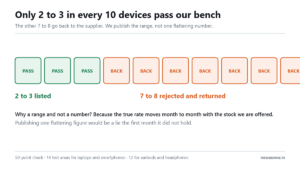
Every device we list is inspected in-house against a 50-point check, and units that do not meet the standard are not listed — that is what “not every product deserves to be sold” means in practice. See how our 50-point quality check actually works and what happens to the devices we reject.
What we will not claim: that we are carbon neutral, that we have quantified our footprint, or that your purchase saved a specific amount of anything. What we will claim: the machines we sell already existed, they work, and we tell you exactly what condition they are in. For the difference between our grades, read unboxed vs refurbished vs Grade A and refurbished vs second-hand.
Devices in stock that already exist
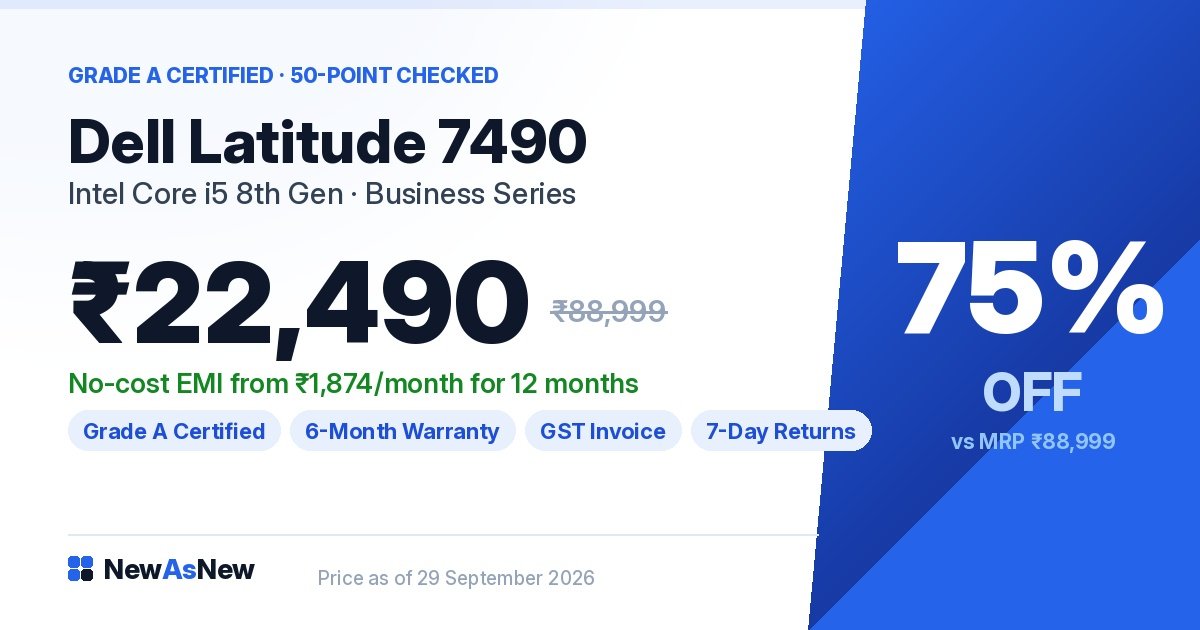
- Dell Latitude 7490 (Core i5, 8th Gen) — Grade A Certified — ₹22,490, 75% off MRP ₹88,999. Ex-corporate, Windows 11 eligible, serviceable for years.
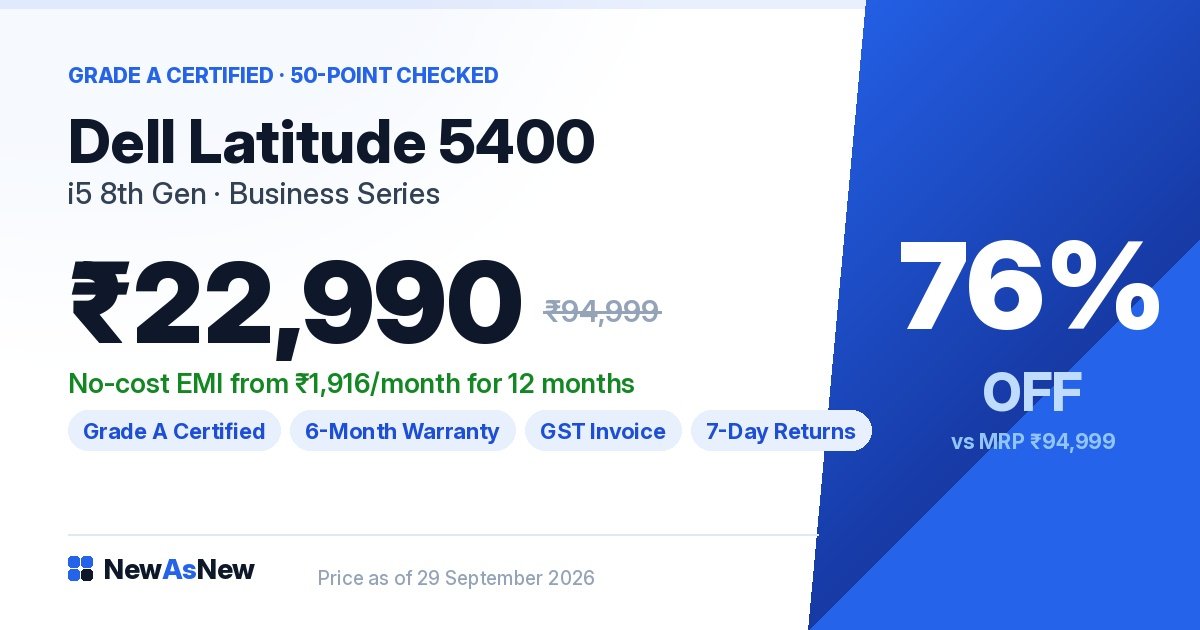
- Dell Latitude 5400 (Core i5, 8th Gen) — Grade A Certified — ₹22,990, 76% off MRP ₹94,999. Designed to be opened and repaired, which is what makes a long life possible.
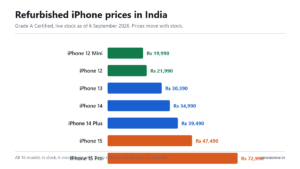
- Apple iPhone 12 — Grade A Certified — ₹21,990, 71% off MRP ₹74,900. A phone with years of use left rather than a new one built to replace it.
- Sony WH-CH520 on-ear headphones — Unboxed — ₹2,790, 53% off MRP ₹5,990. Box opened, product untouched, kept out of a write-down.
Each ships with a written warranty, a GST invoice, 7-day returns and EMI.
Frequently asked questions
Does buying refurbished electronics actually help the environment?
Yes, and the reason is specific. Most of a laptop’s lifetime environmental impact comes from manufacturing it — mining and refining metals, fabricating semiconductors, assembly and global shipping — rather than from the electricity it uses. Buying a restored device that already exists means a new one does not have to be manufactured to replace a working machine. We deliberately do not put a kilogram figure on that, because an honest number varies enormously by model, factory and power grid.
Why don’t you give a CO2 figure for a laptop?
Because this page used to, and we could not trace where those numbers came from, so we removed them. Manufacturing footprints differ by model, by component sourcing, by the electricity grid that powered the factory and by the assumptions of whichever lifecycle study you read. Publishing a single confident figure would look more impressive and be less true.
What should I do with my old laptop or phone?
In this order: keep it working if a battery, a drive or a clean-out will do it; pass it to someone who will use it, after wiping it properly; sell or exchange it so it enters the refurbishment stream; and only then recycle it through an authorised e-waste collection point rather than household waste or a roadside scrap dealer. Never puncture or bin a lithium battery. Reuse preserves the embedded manufacturing value that recycling largely loses.
Is e-waste disposal regulated in India?
Yes. India has national e-waste management rules that place responsibility on producers for the collection and channelling of end-of-life electronics, and authorised recyclers and collection points operate in most major cities. Electronic waste is treated separately from ordinary rubbish because circuit boards, batteries, displays and solders contain hazardous materials including lead, mercury and cadmium.
Is “Unboxed” an environmentally better choice than new?
Yes, for a straightforward reason. Unboxed items are returns, display units or overstock that cannot be sold as new — products that are already finished and fully functional but which are often written down and sometimes destroyed. Selling them honestly at a lower price, with the opened box disclosed, keeps a manufactured product in use rather than wasting it.
Is NewAsNew carbon neutral?
No, and we will not claim it. Inspection, replacement parts, packaging and shipping across India all consume energy and materials, and we have not measured our footprint, so we will not put a label on it. What we can state as fact is what we sell: devices that already exist, inspected against a 50-point check, with their real condition published. If we ever measure our footprint properly, we will publish the method alongside the number.
Browse and ask
For the money side of the same decision, read the real cost of buying new vs certified pre-owned over three years. If you are choosing between grades, start with how to choose between Unboxed and Grade A.
Not sure whether your current device is worth keeping? Message us on WhatsApp with the model and what is wrong with it. If it is worth repairing rather than replacing, we will tell you that — even though it means we do not make a sale.
Written by A Pandey, founder of NewAsNew (NextG Serve Pvt. Ltd., New Delhi). This page was rewritten in September 2026 to remove environmental statistics we could not source. We would rather make a weaker claim we can stand behind than a strong one we cannot. Read why we started NewAsNew.