Airpods & Earbuds (Unboxed)
  Camera & Lenses (Unboxed)
  Headphones (Unboxed)
  Laptops (Unboxed)
  MacBooks (Unboxed)
  Mobile Accessories (Unboxed)
  Monitors (Unboxed)
  Wearables (Unboxed)
  Laptops (Grade A)
  Monitors (Grade A)
  Smartphone (Grade A)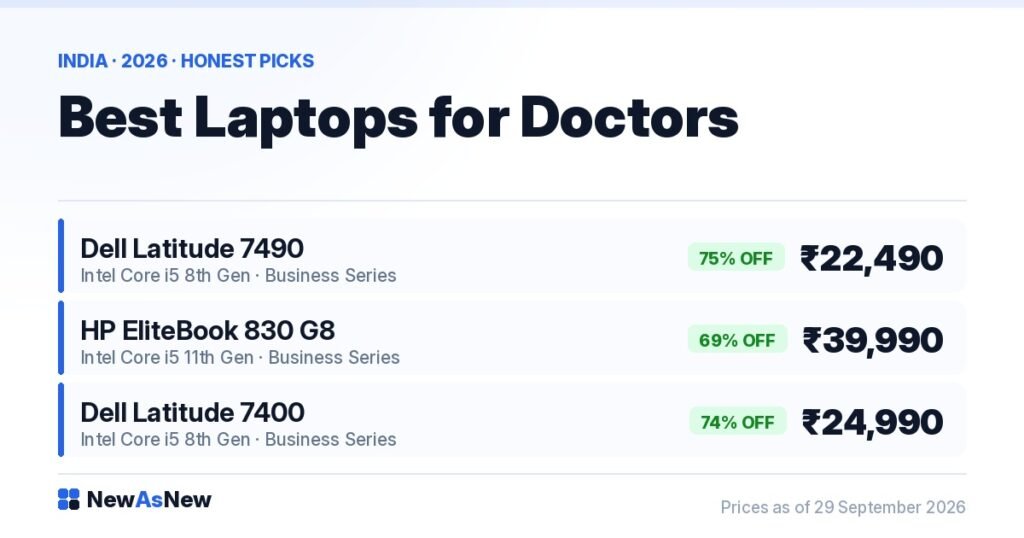
Short answer: For a medical student or a practising doctor, weight and battery beat raw processing power. The Dell Latitude 7490 Core i5 at ₹22,490 (75% off ₹88,999) is the sensible default at 14 inches and roughly 1.4kg. Step up to the HP EliteBook 830 G8 at ₹39,990 for a smaller, newer 13.3-inch machine. Warranty, 7-day returns, GST invoice.
Prices are live as of 29 September 2026 and move with stock — check the linked product page for today’s exact price.
What does a doctor’s laptop actually do all day?
We have sold to MBBS students, PG residents, consultants in private practice and two hospital administrators, and the software list barely changes. It is video lectures. It is PDFs of textbooks and guidelines. It is Anki, often with very large image decks. It is a browser with ten tabs — PubMed, UpToDate, the hospital HIS login, a Google Doc. It is Zoom or Teams for a department meeting. It is Word and PowerPoint for a case presentation or a thesis chapter.
That is a light workload by 2026 standards. Almost nothing on that list is CPU-heavy. Which means the expensive specs — Core i7, dedicated graphics, 32GB of RAM — buy you almost nothing here, and the cheap-to-ignore specs, weight and battery, are the ones that decide whether you actually carry the machine.
The important exception is hospital software. Most Indian hospital information systems are now browser-based or thin-client, and most exam-prep platforms are web apps. A handful of legacy HIS installations still need a Windows client and occasionally a specific browser version. If you are joining a hospital, ask your IT department one question before buying: does anything we use need Windows specifically? Almost always the answer is that a standard Windows business laptop is the safest choice, which is exactly what we sell.
Why weight matters more than processor for ward rounds
A laptop that lives in your bag between the hostel, the library, the ward and the seminar room gets carried five or six times a day. The difference between a 1.4kg ultrabook and a 2.1kg budget laptop is not a spec-sheet detail at that frequency — it is whether the machine comes with you or stays on the desk.
This is why we push medical buyers towards Dell’s 7-series Latitudes and HP’s EliteBook 800-series rather than the cheaper, heavier 5-series machines that we happily recommend to office buyers. They were bought by consultancies and banks for people who travelled, so they were specified light, with magnesium or carbon-fibre chassis, and built to survive being shoved into a bag in a hurry. Our guide on why ex-corporate laptops are built better covers the MIL-STD testing these went through.
Battery is the second half of the same problem. Every laptop we sell is pre-owned, which means the battery has a history. We screen battery health in our 50-point check and state it, but be realistic: a 2018 machine will not give you the ten hours the brochure once claimed. Plan for four to six hours of real mixed use on the 8th Gen units and somewhat better on the 11th Gen ones, and read what 80% battery health actually means day to day before you order. If you will be away from a socket for a full 12-hour shift, budget for a charger you can leave in the duty room.
| You are | What matters most | Our pick | Price |
|---|---|---|---|
| MBBS first or second year | Cost per year, lecture playback, Anki | Dell Latitude 7490 i5 | ₹22,490 |
| Final year / internship | Light enough to carry daily, better battery | Dell Latitude 7400 i5 | ₹24,990 |
| PG resident, thesis + presentations | Newer platform, longer service life, Wi-Fi 6 | HP EliteBook 830 G8 i5 | ₹39,990 |
| Consultant reviewing scans and notes | Touch and pen input, tablet mode for bedside | Dell Latitude 5310 2-in-1 | ₹39,990 |
| Radiologist reporting studies | Calibrated diagnostic display | None of these — see below | — |
Which in-stock laptops we would actually recommend
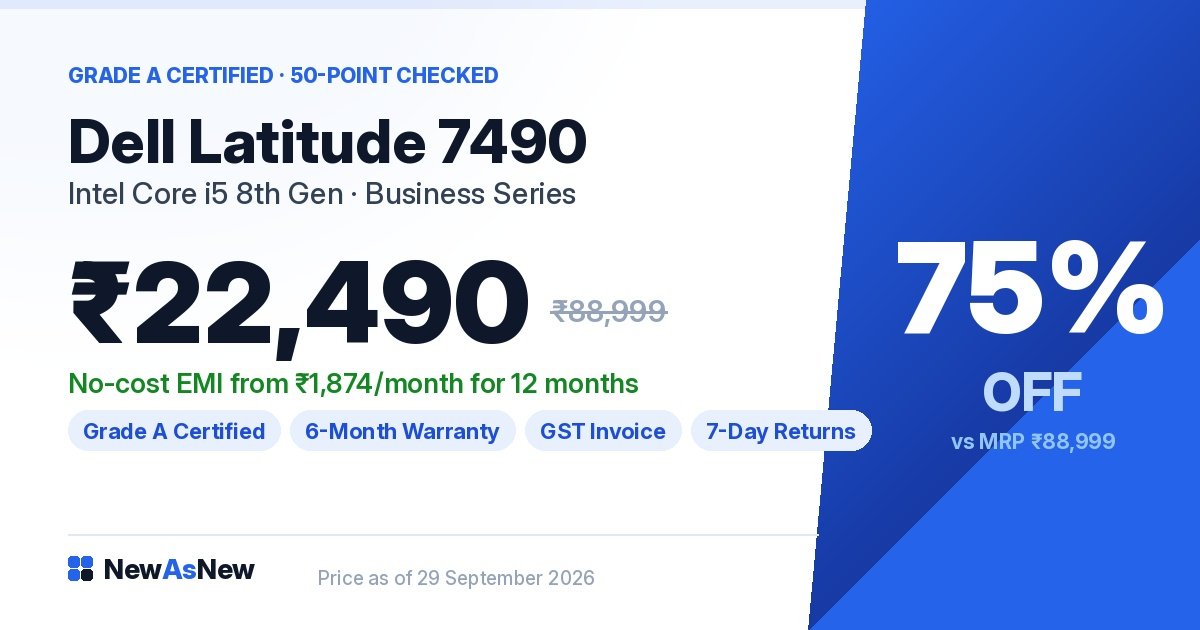
Dell Latitude 7490 Core i5 8th Gen — ₹22,490 (MRP ₹88,999, 75% off). The default recommendation for an MBBS student. 14-inch, around 1.4kg, quad-core i5, SSD. Across a five-and-a-half-year course that works out to roughly ₹340 a month of ownership, and it will still be a usable machine at the end of it. It also has a full set of ports, so a projector in a seminar room is not a dongle hunt.
Dell Latitude 7400 Core i5 8th Gen — ₹24,990 (MRP ₹98,000, 74% off). The 7400 is the generation after the 7490 in Dell’s naming, with slimmer bezels and a slightly more modern feel. If your budget stretches ₹2,500 further, take it — mostly for the chassis and the screen, not the processor. Our 7400 vs 7490 comparison goes through the real differences.
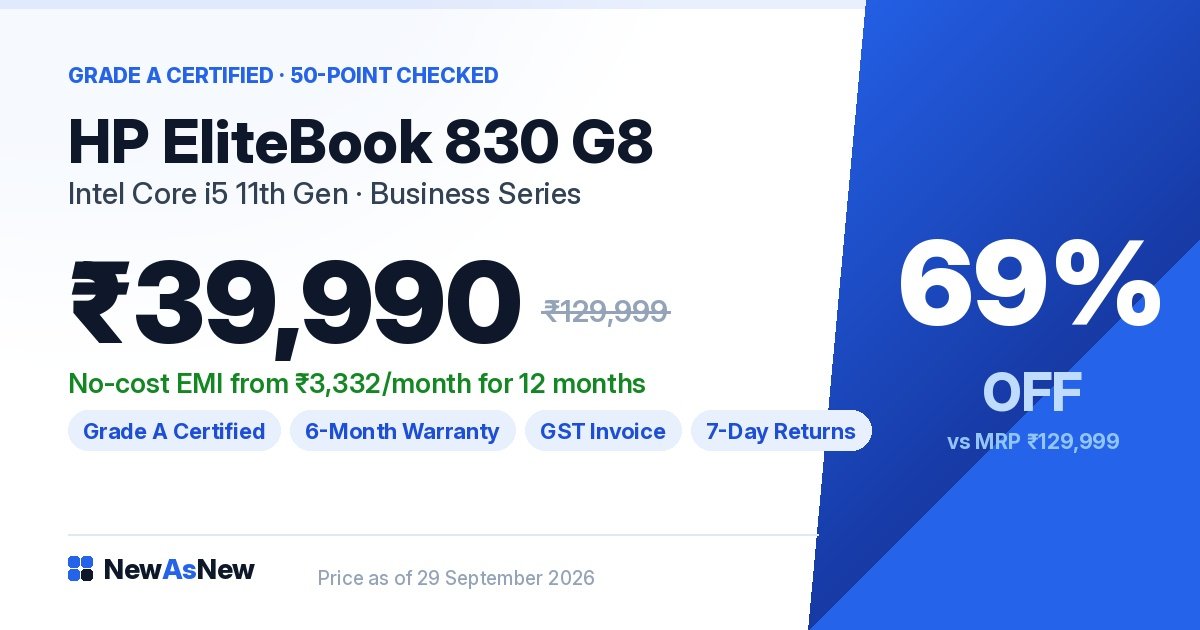
HP EliteBook 830 G8 Core i5 11th Gen — ₹39,990 (MRP ₹1,29,999, 69% off). A 13.3-inch machine — genuinely smaller, not just lighter — on Intel’s 11th Gen platform, which means Wi-Fi 6, Thunderbolt and more years of Windows support ahead of it. For a PG resident buying one laptop to get through residency and the first years of practice, this is the machine we would choose. It is also the best of these for hospital Wi-Fi, which is usually crowded and badly covered.
Dell Latitude 5310 2-in-1 Core i5 10th Gen, 360° convertible — ₹39,990 (MRP ₹89,000, 55% off). Worth it for one specific habit: if you annotate — marking up an ECG PDF, circling a finding on a scan to teach a junior, signing forms, sketching anatomy while studying — a 13.3-inch screen that folds flat is a different tool from a laptop. If you would use it as a normal laptop 95% of the time, buy the cheaper conventional machine instead. More in our 2-in-1 touchscreen roundup.
Is a laptop screen good enough for looking at medical images?
For reviewing, learning and teaching: yes, with caveats. For reporting: no, and this needs to be said clearly.
Diagnostic radiology reporting in India is done on calibrated medical-grade displays for a reason — greyscale calibration, luminance consistency and resolution requirements that no consumer laptop panel meets. No refurbished business laptop, at any price, is a substitute for a reporting workstation. If you are a radiologist, buy the laptop for everything else in your life and report on the hospital’s calibrated setup.
For everyone else — looking at a CT on the ward, going through a teaching file, reviewing a colleague’s case — what you want is a bright panel with decent contrast, because hospital corridors and duty rooms have terrible lighting. Check the brightness figure on the listing; anything from around 300 nits up is comfortable. Our screen specs guide explains what to look for.
Who should NOT buy a refurbished laptop for medical work
Radiologists who report studies. Covered above. A calibrated diagnostic monitor is not optional, and this is not a laptop purchase.
Anyone who mainly wants to read and annotate. If 90% of your day is PDFs, textbooks and marking up notes, an iPad with a pencil may genuinely serve you better than any laptop here. We do not sell one. We would still rather tell you.
Anyone doing serious statistical or genomics work. If your thesis involves large R or Python datasets, sequence analysis or heavy image processing, the 8th Gen ultrabooks are the wrong tool. Look at our under ₹50,000 workstation-grade picks instead, and expect to use institutional compute for the heavy runs.
Anyone who needs one specific piece of Mac-only or legacy software. Confirm compatibility first. A 7-day return window is a safety net, not a plan.
Anyone who will be nowhere near a charging point for 10 hours. Be honest with yourself about this. A pre-owned battery is a pre-owned battery. Check health on arrival — our 60-second battery health check takes less time than reading this paragraph.
Frequently asked questions
Which refurbished laptop is best for MBBS students in India?
The Dell Latitude 7490 Core i5 at ₹22,490. It is light enough to carry all day, handles video lectures, Anki and PDFs comfortably, and costs about ₹340 a month across a five-and-a-half-year course.
Do medical students need an i7 or 16GB of RAM?
No. Lecture videos, PDFs, Anki and a browser are light work. A quad-core i5 with an SSD is enough; 16GB is comfortable but 8GB is workable. See how much RAM you actually need.
Can I view CT and MRI scans on a refurbished laptop?
You can view and learn from them. You should not report from them. Diagnostic reporting requires a calibrated medical-grade display, which no laptop panel is.
How many hours of battery will a refurbished laptop give me on a shift?
Realistically four to six hours of mixed use on the 8th Gen units, a little more on 11th Gen. Battery health is screened and stated in our 50-point check — read what 80% health means for the honest picture.
Is a 13.3-inch laptop too small for medical work?
For carrying daily it is ideal. For long thesis-writing sessions, plug into an external monitor at your desk. That combination beats compromising on portability.
Will hospital software run on a refurbished Windows laptop?
Almost always yes — most Indian hospital information systems are browser-based now. Every machine we sell ships with a genuine Windows licence; details in our Windows licence guide.
Is a 2-in-1 worth ₹15,000 more for a doctor?
Only if you will genuinely write or draw on the screen most days. If not, buy the ₹24,990 conventional laptop and put the difference into an external monitor.
Can I claim this against my practice or get a GST invoice?
Yes. Every order comes with a GST invoice, and a registered clinic or practice can claim input credit. See our GST invoice guide.
Browse more: best refurbished laptops under ₹25,000 · under ₹40,000 · best refurbished laptops for students · how to extend your laptop’s life by 3 years.
Tell us your year and your hospital. Message us on WhatsApp — chat with us at +91 79822 35917 — with your course year or speciality and how much you carry it. If a tablet suits you better than a laptop, we will say so.
Written by the NewAsNew team. Every unit is inspected on our own bench in New Delhi against a 50-point check before listing, and roughly 7 or 8 of every 10 machines we assess are rejected rather than sold. Read our story.